Blog

  • BA staff and plane fanatics hunt for 747 souvenirs

    There is a big market in souvenirs, from seats to side panels, from cabin crew and aviation enthusiasts.

    Image copyright
    Graham Wasey

    The retirement of BA’s 747 fleet has led to a bout of nostalgia from staff and plane fanatics keen for souvenirs. 

    Earlier this month, BA announced it was permanently grounding its fleet of 31 747s amid the coronavirus-led slump in travel demand. 

    Some of these iconic planes will end up at a salvage firm at Cotswold Airport. 

    Air Salvage International’s owner Mark Gregory says he is getting a stream of inquiries from people keen to grab a piece of aviation history. 

    This week, Boeing said it would stop making the 747 planes as airlines opt for newer and more fuel-efficient planes. 

    Mr Gregory has already taken delivery of three BA 747-400s and another three will be delivered in the coming months. He expects the remainder to be sold to other airlines and operators.

    Image copyright
    Graham Wasey

    The 747 is credited as making long-distance air travel more affordable and has a history stretching back five decades. As it slowly disappears, a market is developing for souvenirs, ranging from seats to side panels.

    “I get a daily stream of emails from BA staff and 747 fanatics who want to buy a piece of a plane. A cut-out side section is popular which can be hung on the wall. These usually go for about £200 each,” said Mr Gregory. 

    “They are good aircraft and have done a lot of hours. They have definitely earned their keep.”

    His salvage and trading company has been operating for more than 20 years out of Cotswold Airport, a private airfield near Kemble which was once owned by the Ministry of Defence. 

    But it’s not just BA that is offloading its 747s. Other major airlines are also waving goodbye to their planes. 

    Last week, Australian national carrier Qantas said farewell to the last of its Boeing 747s. The final flight of a Qantas 747 drew a massive kangaroo shape in the sky as it left Sydney Airport. 

    Since the coronavirus outbreak, Air Salvage International has seen a ten-fold increase in inquiries from a number of airlines looking for storage facilities.

    Image copyright
    Graham Wasey

    “We have 11 747s parked up currently. Some are being dismantled while others are up for sale including the BA 747s,” added Mr Gregory. Cotswold Airport has capacity for more than 100 aircraft.

    Breaking up

    A division of his business looks after the dismantling and selling on of aircraft parts. Engines make up around 80% of the value of a retired plane.

    While some engines can easily sell for $3m (£2.3m) each, the Rolls-Royce ones on the BA 747-400s are likely to sell for less.

    Other potentially valuable parts include the wheels and the brakes. But there’s a saturated market for 747 spare parts as more are taken out of service and dismantled. 

    Image copyright
    British Airways/PA Media

    Most retired planes are either dismantled, sold to other airlines or left in storage, often in deserts. Some are also kept by airlines who use the cockpits to train pilots.

    On rare occasions, entrepreneurs buy planes to convert them into a restaurant, hotel or restore for a private collection.

    “Most of these other requests are generally visionaries with little or no budget,” added Mr Gregory. 

    Movie props

    Some of the retired aircraft have even made their way into the movies and scrap parts have been featured in many of the Star Wars films, including Rogue One.   

    “The engines and parts are worth more if you take them off than if you try to sell the aircraft as a flying machine.”  

    The process to dismantle a plane can take around eight weeks for a narrow-bodied passenger jet such as a Boeing 737 or an Airbus A320, while for giants such as a Boeing 747 or 777 it can take 10 to 15 weeks. 

    Severe downturn

    The aviation industry is facing a significant challenge of how to deal with its ageing aircraft, along with a sharp fall in passenger numbers.

    Image copyright
    PA Media

    Of more than 27,000 commercial aircraft in service globally, over 20% are older than 20 years and likely to be decommissioned in the coming decade, according to the International Civil Aviation Organization.

    It estimated last year that more than 20,000 commercial aircraft will be retired over the next 20 years, but that was before the virus pandemic devastated the airline industry.

    Best seller

    The 747-400, which is the model BA is phasing out, first began flying in 1988.

    Boeing sold almost 700 of the 747-400s, making them the best-selling version of the long-range airliner. Now that most are more than 20 years old, they are gradually being retired. 

    But the very first 747s date back to 1969, with Boeing celebrating their 50th anniversary last year.

  • World War II’s Indelible Influence on Technology | Technology

    At 8:15 a.m. local time on the morning of Aug. 6, 1945 the first atomic bomb — codenamed “Little Boy” — was dropped from the B-29 “Enola Gay” on the Japanese city of Hiroshima. It was the first of only two times that an atomic weapon had been used in wartime, and while even 75 years later the event remains controversial. It was a testament to the technological process that occurred during the Second World War.

    When the war broke out on Sept. 1, 1939 with Germany’s invasion of Poland, few could have expected the technological leaps that would occur over the next six years. Military historians have largely focused on the advancement in small arms, and the development of superior tanks and other killing machines, and for good reason.

    World War II was the first conflict to see the use of jet aircraft, although it wasn’t until the Korean War that jets actually went head-to-head against one another. WWII saw the introduction of the assault rifle and notably the missile.

    Yet, this most horrible of conflicts should also be remembered for how much progress was made during the war and can still be seen in the world today.

    The Manhattan Project

    Easily, the most significant advance during the Second World War was the ultra-secret project to develop the atomic bomb. It isn’t hyperbole to suggest that it truly involved the brightest minds on the planet.

    “The importance of the Manhattan Project as leaps forward in science and technology cannot be overstated,” said Dr. David J. Ulbrich, associate professor of military history at Norwich University.

    “The United States needed to win the race against Japan and Germany to create an atomic bomb,” Ulbrich told TechNewsWorld.

    “This wartime priority made the research and development process much faster than in peacetime,” he added. “Warfare thus created the ultimate crisis motivation and thus removed limits on money and resources that existed in peacetime.”
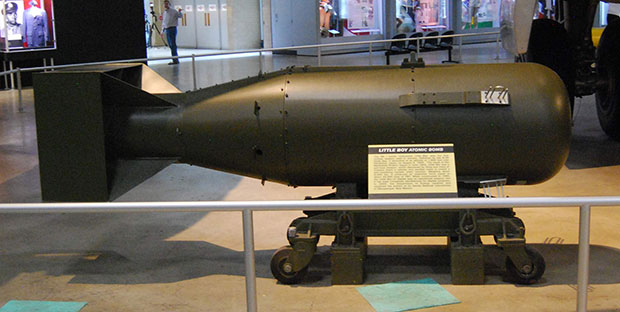
    replica of the Little Boy atomic bomb

    A replica of the “Little Boy” atomic bomb in the collection of the National Museum of the United States Air Force. [Photo by Peter Suciu]


    The project involved several hundred thousand people — including those who pushed the brooms and guarded the scientists and other staff. It was also the most costly military undertaking at that point in history.

    “This entire project cost an estimated US$2 billion in 1940s dollars — which amounted to nearly one percent of all American expenditures of $300 billion during the Second World War,” explained Ulbrich.

    “That is a massive commitment of resources to a single weapon,” he noted. “During the Great Depression in the 1930s, the U.S. military could not even afford to provide small arms for training, nor could the U.S. military find the money for research and development of airplanes and warships.”

    More Than an American Effort

    It is easy today to think of American theoretical physicist J. Robert Oppenheimer leading the efforts, and he is of course remembered for his quote of the Bhagavad Gita in describing the explosion at the Trinity test site in New Mexico on July 16, “Now I am become Death, the destroyer of worlds.”

    The technology used to develop the bomb was notable, as well as the international effort to create it.

    “The Manhattan Project was a truly monumental and historic endeavor — the collaboration between governments, industry, and the science community, with the pointed goal of developing nuclear weapons during World War II, was unprecedented at the time, and actually spurred R&D in energy, technology, and other advanced sectors,” suggested Gilbert Michaud, assistant professor in the online Master of Public Administration Program at the Voinovich School of Leadership and Public Affairs at Ohio University.

    “For instance, lessons learned in nuclear fission in the 1940s helped, in part, lead to nuclear energy as a viable electricity generation asset in the 1950s and to this day,” Michaud told TechNewsWorld.
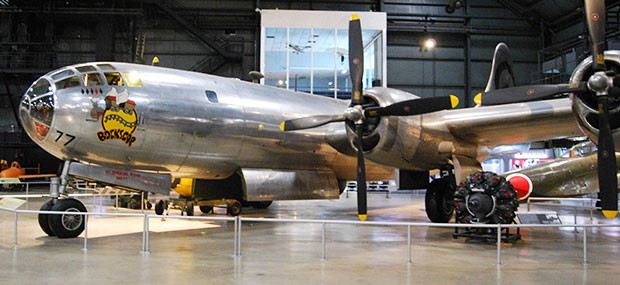
    B-29 bomber Bockscar

    The B-29 was the first bomber aircraft to feature a pressurized cabin, which allowed it to fly higher than previous bombers and avoid enemy anti-aircraft guns. This particular bomber, nicknamed “Bockscar” dropped the second atomic bomb — codenamed “Fat Man” — on Nagasaki on Aug. 9, 1945. The Japanese government surrendered unconditionally on Aug. 15. The aircraft is part of the collection of the National Museum of the United States Air Force. [Photo by Peter Suciu]


    The challenges of making an atomic bomb also involved many scientific questions from how neutrons could be made to split nuclei of atoms into smaller fragments and cause chain reactions.

    “The challenges are involved technological questions about how to harness, control, and detonate the incredible power released by splitting the nuclei and causing the chain reactions,” said Ulrich.

    The Birth of the Computer and More

    Had it not been for the Manhattan Project it is doubtful today’s Internet would exist — and not only because the Internet’s origins were to ensure that a decentralized computer network could survive an atomic attack. But the project was also the catalyst for the development of computers.

    “The process of testing, observing, analyzing, replicating, and recording the science and technology behind the atomic bomb required new methods and devices to be created,” Ulrich added. “For example, researchers needed to make faster and more accurate mathematical calculations than could be done by humans, and the computers provided the answer. Computers could make calculations around the clock with no worries about mistakes caused by fatigue or human errors.”

    Those early computers used during World War II were massive analog devices, but their success in the Manhattan Project and numerous other wartime activities ensured these machines could evolve in the post-war era.

    “Analog computers gave way to digital computers being developed later in the 1940s,” explained Ulrich.

    “The science and technology developments used to split atoms for military purposes also laid the foundation for harnessing that same power for peaceful purposes in the post-World War II era,” he added.

    Other lessons from the Manhattan Project experiments further yielded non-military applications in medicine and science, such as cancer treatments using radiation, clearer understanding of photosynthesis, and increased understanding of radiation’s effects on the environment.

    “This is what we policy scholars call a ‘focusing event’ — basically referring to how a crisis, such as war, and the efforts of Manhattan Project in particular, worked to enhance attention, spark new developments, and accelerate new priorities,” said Michaud. “The Manhattan Project snowballed into the Atomic Energy Act of 1946, broader advancements in technology and electricity generation, and even the establishment of research sites that still operate today, such as the U.S. Department of Energy’s Oak Ridge National Laboratory in Tennessee.”

    On the Road

    Of course, the Manhattan Project was one — albeit a major — part of the effort to ensure victory over the evils of Nazi Germany and Imperial Japan. The “Arsenal of Democracy” was as much about the trucks as the tanks or guns. In fact, it must be noted that Germany’s invasion of the Soviet Union in 1941 was conducted with more horses than the French Emperor Napoleon had used in 1812.

    The United States didn’t rely on horses but instead on horsepower from GM, Ford, Chrysler and others. Those efforts cannot be overstated!

    “Many scholars have pointed to the 2-1/2-ton GMC as one of the primary contributors of the Allied success in World War II,” said John Adams-Graf, editor of Military Vehicles
    magazine.

    “Whereas the Germans may have perfected the ‘Blitzkrieg’ style of armored warfare, the Allies perfected moving armies over great distances,” Adams-Graf told TechNewsWorld.

    In addition, as the Germans discovered — most notably in the 1944 Battle of the Bulge offensive — tanks aren’t enough if you can’t keep them fueled. This is where the Allied trucks proved so crucial in keeping the troops supplied.

    GMC truck in the National World War II Museum in New Orleans

    While tanks fought the battles, it was trucks like this GMC that moved the solidiers and materials to the front. This example is in the collection of the National World War II Museum in New Orleans. [Photo by Peter Suciu]


    “An army that is based on armored vehicles requires a lot of fuel and support,” said Adams-Graf. “The farther out from their base of supply, the more vulnerable they became. Trucks made the longer lines of logistical support possible.”

    The Germans may not have had the trucks, but they did have the Autobahn, which American military planners saw — and it was also used as a blueprint for the national highway plan developed in the 1950s. Anyone taking a long road trip should remember that also is a result of innovations developed and studied during the war.

    Flying High

    Aircraft technology saw tremendous leaps and bounds during the Second World War, most notably in the development of jet aircraft.

    “Aircraft and weapons development advanced exponentially during World War II — major advancements included jet engines, guided bombs, air-to-air and surface-to-air missiles, cruise missiles, radar, and operational helicopters,” explained Jeff Duford, curator at the National Museum of the United States Air Force.

    It wasn’t just the ability to fly faster or to be better armed. Some of the technology truly created the era of the jetsetters and is what allowed tourists to explore the world like never before. But it meant overcoming a serious issue first.

    German Me262

    The German Me262 was one of the first successful jet fighter aircrafts. While it didn’t change the outcome of WWII, it paved the way for jet fighters in the Cold War. This example is in the collection of the National Museum of the United States Air Force. [Photo by Peter Suciu]


    “As aircraft flew higher and higher, the limits of the human body at high altitude became an increasing problem,” Duford told TechNewsWorld.

    “In the 1930s, U.S. Army Air Corps personnel at Wright Field, Ohio developed solutions for this problem, one of which was cabin pressurization,” he added. “By the end of World War II, cutting-edge aircraft like the B-29 Superfortress were pressurized, which greatly increased crew comfort, efficiency, and endurance.”

    First Step to the Moon

    It would be another 25 years before Neil Armstrong would take the first small step for a man on the moon, but the giant leap to the moon arguably began in 1944 when Nazi Germany developed its V-1 rockets, which were used in a terror campaign against London.

    Neither the V-1 nor its follow-up V-2 were the miracle weapons that turned the tide of war for the Germans, but the technology was used by both the Soviet and Americans in the early days of the space race.

    “On a practical level, German V-2 rockets in World War II foreshadowed the intercontinental ballistic missiles of the Cold War Era,” noted Ulrich.

    “They also opened up possibilities of sending man-made vehicles outside the earth’s atmosphere and maybe even to the moon,” he added.

    “It’s fair to say that the German V-2 rocket of WWII was a technological ancestor of the giant Saturn rockets of NASA’s moon program,” suggested Dr. Douglas Lantry, historian at the National Museum of the United States Air Force.

    “[The rockets] shared the basic functional aspect of liquid propellants in large quantities mixed and ignited to create terrific thrust,” Lantry told TechNewsWorld.

    “Their most important difference was that the V-2 was a ballistic missile and a terror weapon, while the much more powerful multi-stage Saturn was a space launch vehicle used for peaceful exploration,” added Lantry.

    On a scientific methodology level, the German V-1 and V-2 rockets also paved the way for problem-solving processes.
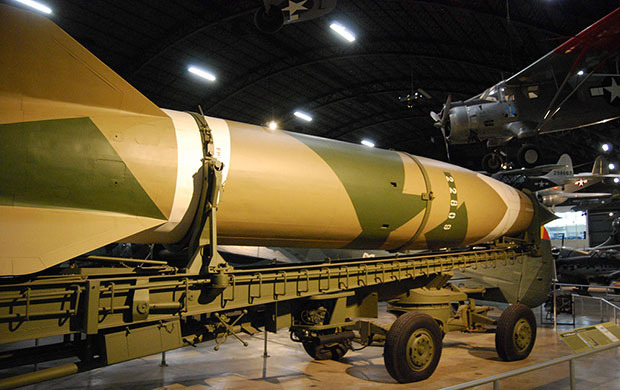
    German V2 rocket

    The German V2 rocket brought destruction to London, but the technology behind it helped bring a man to the moon. This captured example is in the collection of the National Museum of the United States Air Force. [Photo by Peter Suciu]


    “Germany’s engineers like Wernher von Braun took the knowledge and lessons during World War II and then applied those to bigger, more ambitious projects after the war ended,” said Ulrich.

    “Yes, the engineers and scientists developed new gadgets, but more importantly than that, they adapted habits of mind that enabled them about to think bigger, faster, and farther innovations than the V-2 rocket’s 200-mile range, the 55-mile flight ceiling, and 3,850 miles per hour speed,” Ulrich explained.

    That was really not that far of a leap to the bigger, faster rockets used during the Cold War.

    “Saturn benefited from the engineering, organizational, and promotional talent of von Braun, who also developed the V-2. Postwar research and development using vast American resources allowed von Braun to become the chief creator of rockets that sent astronauts to the moon,” said Lantry.

    From Swords to Plowshares

    The true lasting impact of the technological advances of the Second World War are seen in the ability to take commercial jets around the world, the ever-bigger cruise ships (at least if that industry is able to survive the Covid-19 pandemic) and of course in the massive skyscrapers seen in cities all over the globe.

    With peace came a new world of opportunity that lead to the Internet and much more.

    “The incredible scientific and technological achievements during World War II opened people’s eyes about what could be developed or invented, given enough resources and commitment,” said Ulrich.

    Simply put, no problem seemed too hard or too big to solve.

    “Scientists and engineers became what amounted to the high priests in a materialistic religion that worshipped gadgets and concepts,” added Ulrich. “Other activities, such as improving manufacturing processes or building suburbs, interstate highway systems, and inexpensive houses, were also much easier to conceive.

    “During World War II, America figured ways to build 1,200 major warships, 300,000 aircraft, 675,000 ‘deuce and a half’ trucks, and 25 billion rounds of .30-caliber ammunition. Meanwhile, they researched and developed the atomic bomb. So, the post-war years saw Americans quickly put their wartime techniques to work in massive peacetime projects.”


    Peter Suciu has been an ECT News Network reporter since 2012. His areas of focus include cybersecurity, mobile phones, displays, streaming media, pay TV and autonomous vehicles. He has written and edited for numerous publications and websites, including Newsweek, Wired and FoxNews.com.
    Email Peter.
  • News Corp: Rupert Murdoch’s son James quits company

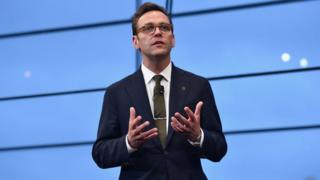
    : CEO of 21st Century Fox James Murdoch speaks at National Geographic's Further Front Event at Jazz at Lincoln Center on April 19, 2017 in New York City.

    Image copyright
    Getty Images

    James Murdoch, the younger son of media mogul Rupert Murdoch, has resigned from the board of News Corporation citing “disagreements over editorial content”.

    In a filing to US regulators, he said he also disagreed with some “strategic decisions” made by the company.

    The exact nature of the disagreements was not detailed.

    But Mr Murdoch has previously criticised News Corp outlets, which include the Wall Street Journal, for climate change coverage.

    Rupert Murdoch, News Corp’s executive chairman, and his other son Lachlan, co-chairman, wished James well in a joint statement.

    “We’re grateful to James for his many years of service to the company,” the statement said. “We wish him the very best in his future endeavours.”

    Representatives of Mr Murdoch and his wife Kathryn have acknowledged the couple’s “frustration” with coverage of the subject by some of most influential Murdoch-owned news brands, including Fox News.

    They have also spoken of particular disappointment about climate change denial in Murdoch-owned Australian outlets.

    News Corp also owns The Times, The Sun and The Sunday Times in the UK, as well as a stable of Australian newspapers, including The Australian, The Daily Telegraph and The Herald Sun.

    What do we know about past disagreements?

    Earlier this year, amid devastating wildfires in Australia, Mr Murdoch and his wife Kathryn expressed their frustration with climate change coverage by News Corp and Fox.

    Their spokesperson told The Daily Beast they were “particularly disappointed with the ongoing denial among the news outlets in Australia given obvious evidence to the contrary.”

    Rupert Murdoch has described himself as a climate change “sceptic” and denies employing climate deniers.

    But critics of News Corp pointed to its comment articles and reporting of the alleged role of arson in the wildfires as minimising the impact of a changing climate.

    • Employee attacks Australia fires media coverage
  • Australia unveils plan to force Google and Facebook to pay for news

    A phone with a Facebook icon

    Image copyright
    Getty Images

    The Australian government has unveiled its plan to force tech giants such as Google and Facebook to pay news outlets for their content.

    Treasurer Josh Frydenberg said the “world-leading” draft code of conduct aimed to give publishers “a level playing field to ensure a fair go”.

    Many news outlets have shut or shed jobs this year amid falling profits.

    Facebook and Google strongly oppose the proposal, even suggesting they could walk away from Australia’s news market.

    Mr Frydenberg said the code of conduct – drafted by Australia’s competition regulator – would be debated by parliament.

    It could impose “substantial penalties” worth hundreds of millions of dollars on tech companies which fail to comply, he said.

    What’s in the draft code?

    The Australian Competition and Consumer Commission draft calls on tech companies to pay for content, though it does define what it is worth.

    It would allow news companies to negotiate as a bloc with tech giants for content which appears in their news feeds and search results.

    If negotiations fail, the matter could be arbitrated by the Australian Communications and Media Authority.

    The draft code covers other matters too, including notifying news companies of changes to algorithms.

    Penalties could be up to A$10m (£5m; $7m) per breach, or 10% of the company’s local turnover.

    The code will initially focus on Google and Facebook but could be expanded to other tech companies, the treasurer said.

    What are the arguments?

    Mr Frydenberg said: “Nothing less than the future of the Australian media landscape is at stake with these changes.”

    “Today’s draft legislation will draw the attention of many regulatory agencies and many governments around the world,” he said.

    Australia’s biggest media companies have lobbied hard for the proposal.

    It was a “watershed moment” in efforts to end “free-riding” by the tech companies, News Corp Australia executive chairman Michael Miller said on Friday.

    Google’s local managing director, Mel Silva, said the company was “deeply disappointed” and argued the move would discourage innovation.

    “The government’s heavy-handed intervention threatens to impede Australia’s digital economy and impacts the services we can deliver to Australians,” she said.

    Facebook has previously suggested it could remove Australian news from its platform if such requirements were imposed – arguing the cost to its business would be negligible.

    What next?

    The code of conduct will be subject to a month-long consultation period before being debated in parliament “shortly after” August, Mr Frydenberg said.

    If legislation is passed, the code is designed to be reviewed after a year.

  • Twitter hack: Florida teenager arrested

    Twitter hack graphic

    Image caption

    Elon Musk, Kim Kardashian and Barack Obama are among victims of the hack

    A teenager in Florida has been arrested over a major Twitter hack in July, according to the Hillsborough State Attorney’s Office.

    On 15 July, Twitter accounts of multiple high-profile US figures were hijacked in an apparent Bitcoin scam.

    Hillsborough State Attorney Andrew Warren has filed 30 felony charges against the teenager for “scamming people across America”.

    The charges include organised fraud and fraudulent use of personal information.

    The attack saw high-profile accounts such as Elon Musk, Microsoft founder Bill Gates, Amazon boss Jeff Bezos, Democratic presidential hopeful Joe Biden, former US President Barack Obama and reality star Kim Kardashian West falsely tweet out requests for Bitcoin donations.

    “As a cryptocurrency, Bitcoin is difficult to track and recover if stolen in a scam,” Mr Warren said in a statement.

    “These crimes were perpetrated using the names of famous people and celebrities, but they’re not the primary victims here. This ‘Bit-Con’ was designed to steal money from regular Americans from all over the country, including here in Florida.

    “This massive fraud was orchestrated right here in our backyard, and we will not stand for that.”

    Image copyright
    AFP/REUTERS

    Image caption

    Kim Kardashian West, Kanye West, Elon Musk, Bill Gates and Barack Obama were all ‘hacked’

    The charges against the teenager include 17 counts of communication fraud, 10 counts of fraudulent use of personal information, one count of fraudulent use of personal information with over $100,000 (£76,340) or 30 or more victims, one count of organised fraud and one count of access to computers or electronic devices without authority.

    Mr Warren said the investigation to “discover the perpetrator” was a collaboration between the Florida Department of Law enforcement, the US Attorney’s Office for the Northern District of California, the FBI, the IRS, and the Secret Service.

    The teenager lives in Tampa, Florida and so will be prosecuted by Hillsborough State authorities.

    Twitter said in a statement: “We appreciate the swift actions of law enforcement in this investigation and will continue to cooperate as the case progresses.

    “For our part, we are focused on being transparent and providing updates regularly.”

    After the hack, Twitter said the hackers had targeted its employees “with access to internal systems and tools”.

    It added that “significant steps” had been taken to limit access to such internal systems and tools while the company’s investigation continues.

    According to BBC cyber-security reporter Joe Tidy, the consensus in the information security community is that Twitter’s employees were likely duped by a spear-phishing attack via a phone call.

    This involves using friendly persuasion and trickery to get victims to hand over crucial information that enables hackers to infiltrate a company’s systems.

  • Twitter bans ex-KKK leader David Duke

    Twitter logo

    Twitter has permanently banned white nationalist David Duke for repeatedly violating its rules about “hateful conduct”.

    The social network changed its policy in March and no longer lets people share links to articles that include “hateful content” or incite violence.

    The Anti-Defamation League (ADL), an anti-hate organisation, describes Duke as “perhaps America’s most well-known racist and anti-Semite”.

    He was banned from YouTube in June.

    Duke’s final tweet linked to an interview he had conducted with Germar Rudolf, who was convicted of Holocaust denial in Germany where it is a criminal offence.

    His penultimate tweet promised to expose the “systemic racism lie”, while another claimed to expose the “incitement of violence against white people” by Jewish-owned media.

    Duke founded the Knights of the Ku Klux Klan in the 1970s.

    He pleaded guilty to tax fraud in 2002 and spent a year in a US prison.

  • Byron Burger sheds 650 jobs and closes more than half its outlets

    Byron Burger outlet

    Image copyright
    TOLGA AKMEN

    Restaurant chain Byron Burger is closing permanently more than half its 51 outlets and cutting 650 jobs.

    It is part of a deal that will see the remaining 20 sites and 551 staff transfer to a new owner, Calverton UK.

    Many of the restaurants were already closed, victims of the economic impact on the hospitality sector of coronavirus.

    Will Wright, an administrator at KPMG who sold the chain, said the pandemic’s impact “on Byron has been profound”.

    He added: “After exploring a number of options to safeguard the future of the business and following a competitive sales process, this transaction ensures Byron will continue to have a presence on our high streets.”

    It was believed that KPMG was in talks with three potential buyers, which were were looking at taking over the whole firm or parts of it.

    • Restaurants are ‘hurting’, says Deliveroo boss
    • 6,000 jobs at risk at Cafe Rouge and Bella Italia

    Founded in 2007, Byron has been struggling for a number of years. In 2018 it agreed a rescue plan and restructuring which was handled by KPMG.

    As part of that deal, investment house Three Hills Capital Partners became the biggest shareholder.

    ‘Great opportunity’

    Under the deal, Byron Burger’s existing investors will take a minority stake in the business, KPMG said. No financial details were disclosed.

    Sandeep Vyas, of Calveton said: “Byron is a pioneering brand much loved by customers across the UK. We are backing Byron because we believe it has great opportunity ahead of it, and it is well placed to adapt to the new consumer environment and dining trends.”

    He said the new investors would look to boost the chain’s digital on-demand platforms.

    Restaurant chains, which were already under pressure before the coronavirus crisis, have been hit hard by the pandemic.

    The owner of Cafe Rouge, Casual Dining Group, and Bella Italia-owner Azzurri, are among several chains to fall into administration during lockdown.

  • Coronavirus: Scotland developing its own contact-tracing app

    Apple Google app

    Scotland is developing its own coronavirus contact-tracing app, which it hopes to have ready for use in the autumn.

    It follows the failure of an NHS-branded app in England, which was trialled on the Isle of Wight.

    On Thursday, Northern Ireland became the first part of the UK to deploy a contact-tracing app.

    Both Scotland and Northern Ireland decided to adapt software already being used in the Republic of Ireland.

    Contact-tracing apps are designed to help prevent a second wave of the coronavirus.

    They work by logging when two people have been in close proximity to each other for a substantial period of time.

    If one of the users is later diagnosed as having the disease, an alert can be sent to others they have recently been close to, telling them that they should also get tested and/or self-isolate.

    In May, Apple and Google updated their mobile phone operating systems to include a framework for contact tracing.

    It carries the process out on the handsets themselves, making it more difficult for the authorities or potentially hackers to de-anonymise the records and use them for other means.

    However, it means governments and epidemiologists also cannot access the data centrally to analyse it.

    Media playback is unsupported on your device

    Media captionWATCH: What is contact tracing and how does it work?

    England initially opted to design a centralised contact-tracing app, despite the Apple-Google framework being more widely supported by European countries.

    In June, after a trial on the Isle of Wight which highlighted significant shortcomings, England said it would switch to the Apple-Google model.

    Since Scotland is adapting the Republic of Ireland app, which uses the Apple-Google framework, it will also be compatible with the apps used Northern Ireland and Gibraltar.

    Scotland’s Health Secretary Jeane Freeman said existing manual contact tracing would continue to be used alongside the app.

    “We also know that not everyone uses a mobile phone or will be able to access the app, which is why this software is very much there to complement existing contact-tracing methods,” she said.

    Scotland’s app will be developed by Nearform, which worked on the Republic of Ireland’s contact-tracing app.

  • Coronavirus: Lockdown easing delay ‘is hammer blow’

    Beauty salon worker

    Image copyright
    PA Media

    Image caption

    Under current restrictions, beauty salons can do nails but not eyebrows

    The decision to delay a further easing of coronavirus restrictions in England is “a hammer blow” to companies and consumers, says one business group.

    The delay means that places such as casinos and bowling alleys, which had been due to open on 1 August, will have to wait at least two weeks more.

    Many beauty treatments will also continue to be outlawed.

    The move has come when many firms were “starting to get back on their feet”, said the British Chambers of Commerce.

    BCC co-executive director Claire Walker said: “While tackling the public health emergency must be the priority, these announcements – made at short notice – will be a hammer blow to business and consumer confidence at a time when many firms were just starting to get back on their feet.

    “Business communities need as much clarity as possible from government if they are to plan ahead and rebuild their operations in the coming months.”

    The National Hair and Beauty Federation also reacted with dismay.

    Treatments on the face, which were excluded when beauty salons were allowed to reopen in England on 13 July, were due to be given the go-ahead from Saturday, but this has now been postponed.

    “We are extremely disappointed that this last-minute decision has been made,” the federation said. “We will continue to push for financial support following this further setback.”

    ‘Safety first’

    The CBI said the news would be “a real disappointment for some businesses”. “But firms know that public safety comes first.” added the CBI’s chief UK policy director, Matthew Fell.

    Both the BCC and the CBI called for extended support and targeted measures to help businesses affected.

    “Businesses will continue to do what is necessary to avoid an infection spike,” said the CBI’s Mr Fell.

    “Delayed reopening will unfortunately lead to even more financial pressure for some companies. So there may yet be a need for more direct support to shore up cash flow, including extended business rates relief.”

    Image copyright
    Getty Images

    UK Hospitality said the delay was “devastating news” for hospitality businesses and leisure venues that had hoped to be back in business this weekend.

    “They have spent a lot of time and money, which they can ill afford to lose at the minute, getting ready to reopen. For those people who work in those sectors, the security of their jobs remains uncertain,” said its chief executive, Kate Nicholls.

    “We now need clear communication to ensure that consumer confidence is not damaged further. We are also going to need further support for those businesses that cannot reopen.”

    The news came in a briefing from Prime Minister Boris Johnson, who said planned reopening for 1 August would be delayed for at least a fortnight.

    That means venues such as casinos, bowling alleys, and skating rinks must remain closed until 15 August.

    Indoor performances will also not resume and pilots of larger gatherings in sports venues and conference centres will not take place, while wedding receptions of up to 30 people will not be permitted.

    Separately, face coverings will be compulsory in more indoor settings where people are likely to come into contact with people they do not know, such as museums and places of worship, from next weekend. They are already required in shops and indoor transport hubs.

    The prime minister said the rules for face coverings would become enforceable in law from 8 August.

  • Twitter hack: Staff tricked by phone spear-phishing scam

    A four-part compiste shows Bill Gates, Kim Kardashian, the Twitter logo, and Joe Biden

    Image copyright
    Reuters

    The unprecedented hacking of celebrity Twitter accounts this month was caused by human error and a spear-phishing attack on Twitter employees, the company has confirmed.

    Spear-phishing is a targeted attack designed to trick people into handing out information such as passwords.

    Twitter said its staff were targeted through their phones.

    The successful attempt let attackers tweet from celebrity accounts and access their private direct messages.

    The accounts of Microsoft founder Bill Gates, Democratic presidential hopeful Joe Biden and reality star Kim Kardashian West were compromised, and shared a Bitcoin scam.

    It reportedly netted the scammers more than $100,000 (£80,000).

    The attack has raised concerns about the level of access that Twitter employees, and subsequently the hackers, have to user accounts.

    Twitter acknowledged that concern in its statement, saying that it was “taking a hard look” at how it could improve its permissions and processes.

    “Access to these tools is strictly limited and is only granted for valid business reasons,” the company said.

    Not all the employees targeted in the spear-phishing attack had access to the in-house tools, Twitter said – but they did have access to the internal network and other systems.

    Once the attackers had acquired user credentials to let them inside Twitter’s network, the next stage of their attack was much easier.

    They targeted other employees who had access to account controls.

    Analysis

    By Joe Tidy, cyber-security reporter

    Twitter isn’t clarifying whether or not their employees were duped by an email or a phone call. The consensus in the information security community is that it was the latter.

    Phonecall spear-phishing, commonly known as vishing, is bread and butter for the sort of hackers who are suspected of this attack.

    The criminals obtained the phone numbers of a handful of Twitter staff and, by using friendly persuasion and trickery, got them to hand over usernames and passwords that gave them an initial foothold into the internal system.

    • Twitter hack: What went wrong and why it matters
    • FBI investigates major Twitter hack

    As Twitter puts it, the scammers “exploited human vulnerabilities”. You can imagine how it possibly went:

    Hacker to Twitter employee: “Hi, I’m new to the department and I’ve locked myself out of the Twitter internal portal, can you do me a huge favour and give me the login again?”

    The fact that Twitter staff were susceptible to these basic attacks is embarrassing for a company built on being at the forefront of digital technology and internet culture.

    Twitter said the initial spear-phishing attempt happened on 15 July – the same day the accounts were compromised, suggesting the accounts were accessed within hours.

    “This attack relied on a significant and concerted attempt to mislead certain employees and exploit human vulnerabilities to gain access to our internal systems,” the company said.

    “This was a striking reminder of how important each person on our team is in protecting our service.”

    Media playback is unsupported on your device

    Media captionTechnology explained: What is phishing?

    Twitter did not state whether the attack involved voice calls, despite a previous report from Bloomberg stating that at least one Twitter employee was contacted by attackers through a phone call.

    Phishing is most commonly done by email and text message, encouraging recipients to click on links that take them to websites with fake log-in screens.

    Spear-phishing is a version of the scam targeted at one person or a specific company, and is usually heavily customised to make it more believable.