Category: iT news

  • Twitter’s Security Blunder: More Dangerous Than You Think | Tech Buzz

    Twitter had a data security problem last week that might sound trivial. Email addresses, phone numbers, and the last four digits of the credit cards used to buy ads on Twitter were left in browser cache after the transaction, and that cache was not secured.

    This may seem trivial, but the consequences could be far more significant than you might think. Let’s explore how — and we’ll close with my product of the week that is arguably the best non-Apple smartwatch currently in the market: the Suunto 7, which uses Qualcomm’s Snapdragon 3100 platform.

    Phishing and Phone Fraud

    When we largely shifted to working at home, a lot of people suddenly had tons of time on their hands and flipped to doing bad things. One of those things was mining people for money and information. Fraudsters know that folks working at home are distracted and worried, which leads to more potential victims.

    A typical phishing attack, be it in the form of an email or phone call, attempts to convince you that the contact is from someone you trust. Then they use bits of information they have about you to mine you for enough additional information to do real damage.

    If some of your data has been obtained illicitly because one of your vendor’s systems was compromised, the crooks can then come after you for more, on the phone. A typical call might go like this:

    A fake caller ID number will show up to make the call you receive look legitimate, because the caller used a spoof app.

    You: Hello

    Attacker: Hello, this is [fake name], account supervisor at [Your Familiar Vendor]. We had a problem with your credit card with the last four digits of [the number they captured from Your Familiar Vendor], and the transaction failed to clear. Could you help us resolve the issue?

    You: Sure

    Attacker: Given the COVID-19 mess, you are ok, right?

    You: Yes

    Attacker: Anyway, given the COVID-19 mess, there have been a lot of fake accounts set up, and we need to make sure you are you. I hope you understand.

    You: I do

    Attacker: So, the email we have for you is [captured email address].

    You: Yes

    Attacker: And the phone number we have is the one I just called [gives captured phone number], correct?

    You: Yes

    Attacker: Do you have the credit card you used with you?

    You: Yes

    (The reason for all of these questions is not only to get you to believe they are who they say there are, but to get you saying “yes” repeatedly so you will continue to cooperate.)

    Attacker: Oh, it looks like the system purged the expiration date of your card, what was that again?

    You: Read the date to the attacker

    Attacker: Ok, let’s try to run it again. Hang on. Some time passes. Sorry, the card still isn’t clearing. Do you think you might have miskeyed the number? I’m so sorry for the trouble, could you give me the number again?

    (If they do this right, you are now convinced they are from Your Familiar Vendor.)

    You: Share the number

    Attacker: It still isn’t clearing, let’s double-check one more thing, that little number on the back of the card, would you mind reading to me?

    Now, if you do, they have everything they need to charge your credit card, but they can then use this information to phish for even more using a similar methodology. For instance, the attackers could call back and this time say they are from Amazon (effective because most people do business with Amazon); repeat back the card information they have, say there is a problem, and then get another one or two card numbers and more information from you by pretending your cards have issues.

    This process could iterate over weeks until they have enough information about you to steal your identity. If they succeed, it will take months or years to get your life and credit rating back. Not to mention the grief you are likely to get from your loved ones for falling for the scam.

    Wrapping Up: Be Prepared

    Now, forewarned is forearmed. So, knowing this, if you have advertised on Twitter, be on alert for anyone calling with some of your personal information and asking for more. Particularly if they have the information you know was leaked, but they could have phished your kids or spouse, so they may know more.

    One recommended practice is never to provide information over the phone about your finances unless you made the call and verified it was to a business and location that you trust. Any inbound call, email, or text message, asking anything about your personal information or finances should be distrusted.

    If you are concerned, look up the number to the company and initiate a phone call to them yourself to review your account to see if there is a problem.

    Or, log into the company’s website by typing their URL directly into your browser (don’t click on links in emails, those could be phishing scams), so you can do a review to see if there are any flags on the account. If not, and generally, there won’t be, you probably avoided being hacked.

    For kids and older folks, you might want to role play with them so they won’t fall for these scams and they will always be on the lookout. People that do this stuff well are great at finding the weak link in the family, and that means you need to assure that whoever yours is, they are ready for this challenge.

    Rob Enderle's Technology Product of the Week

    The Apple Watch remains the best smartwatch in the market. Still, Apple, in its infinite wisdom, decided not to repeat the policy they had with their other consumer devices and locked the watch to the Apple ecosystem. If you don’t have an iPhone, the Apple Watch isn’t for you. That’s why I continuously look for non-Apple challengers, and the best are running the Qualcomm Wear 3100 technology.

    The latest of the watches running this I’ve tried is the Suunto 7, and while it doesn’t yet do what the Apple Watch does, it is, so far, the most impressive Android smartwatch I’ve tested to date.

    What makes this watch better than most is its 1,000 nit 1.39″ AMOLED display. Most smartwatches wash out severely in sunlight, but 1,000 nits are what military-grade displays put out — and being able to see the display on your watch is essential.

    The Suunto 7’s AMOLED display is more advanced than the Apple Watch OLED, but there are tradeoffs. OLED is better in sunlight, uses less power, and has deeper blacks. Still, AMOLED displays have a higher contrast ratio, tend to be harder to break because they are more flexible, and in most cases provide sharper images.
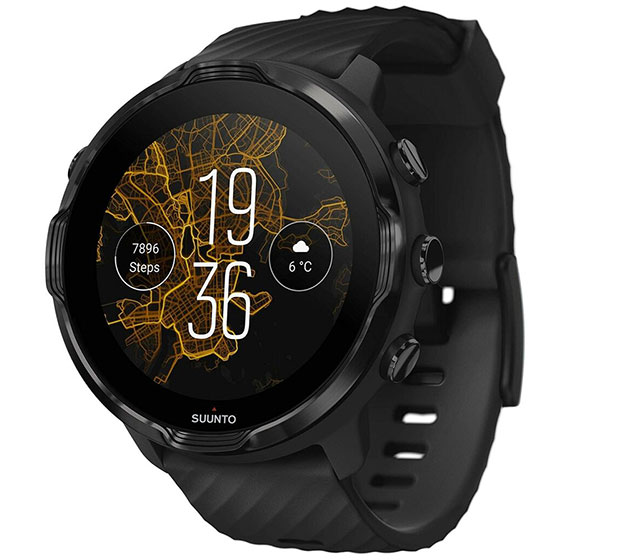
    Qualcomm-based Sunnto 7 smartwatch

    Suunto 7 Smart Watch

    While this isn’t a dedicated sports watch, it does have decent step tracking and a reliable GPS component for runners. Like most watches today, it supports contactless pay with NFC using Google Pay.

    Although it will help you control your music, it doesn’t support offline music (you can’t store music on the device), and it doesn’t have a built-in WAN modem, so you do need your phone in proximity for this and other phone-integrated features.

    The Suunto 7 doesn’t have a sleep tracker, which is a deal-breaker for many, but I find I charge my smartwatch at night anyway, so that hasn’t been a substantial problem for me. Its heart rate sensor has tested well against chest-mounted sensors, so it is more accurate than most.

    One exciting feature is the Suunto heat map, which tracks routes used by other Suunto owners. This feature won’t be beneficial if there aren’t any in your area, but if there are, it can help you discover new running and riding routes.

    It is one of the more attractive watches and an interesting blend of sports and fashion features, and it hit a sweet spot for me, so the Suunto 7 smartwatch is my product of the week.

    The opinions expressed in this article are those of the author and do not necessarily reflect the views of ECT News Network.


    Rob Enderle has been an ECT News Network columnist since 2003. His areas of interest include AI, autonomous driving, drones, personal technology, emerging technology, regulation, litigation, M&E, and technology in politics. He has an MBA in human resources, marketing and computer science. He is also a certified management accountant. Enderle currently is president and principal analyst of the
    Enderle Group, a consultancy that serves the technology industry. He formerly served as a senior research fellow at Giga Information Group and Forrester.
    Email Rob.
  • HP’s Exemplary Reaction to COVID-19 | Best of ECT News

    This story was originally published on April 27, 2020. As a result of popularity, it is presented today as part of our Best of ECT News series.

    Some of the corporate responses to COVID-19 make me incredibly happy I don’t work for a large company anymore. Some of the troubling reports from other companies include forced work in unsafe areas, not enough — or any — protection gear, massive layoffs and furloughs, and the sense that a critical mass of well-paid CEOs and politicians don’t get that many people live paycheck to paycheck.

    If I were to focus on that, however, it would just get you and me depressed, and none of us need help getting depressed now.

    There are exceptions though. One company I follow stepped up, thanks to HR VP Tracy Keogh and CEO Enrique Lores. Of the responses I’ve reviewed so far, they stand out for moving aggressively to protect not only its employees’ lives but also their quality of life.

    I’ll explore their approach and close with my product of the week: iProov, a facial recognition product that overcomes the problem of deepfakes without needing a special camera. It is being used to help with social distancing at scale for government and banking, and would be useful for healthcare.

    What Sets Apart HP

    HP is a vastly different company. It was split off from the old Hewlett Packard, and then-CEO Meg Whitman saddled it with the declining businesses and most all the combined firm’s massive debt. Those decisions almost immediately put the firm on deathwatch. I recall talking to one of the competing CEOs who thought then-CEO Dion Weisler got so excited about becoming CEO he didn’t realize it was a death sentence.

    However, he did know the risk. Starting in crisis forced the firm to rethink its operating policies and procedures, governance, employee measurement systems and corporate rules. In effect, HP came close to tossing out everything and starting over, making the firm into one mammoth startup.

    The result was a firm that was more focused on customer and employee care, and less focused on making Wall Street happy than its parent was, and HP was far more agile as well. Internal communications were stronger, the focus on creating and maintaining trust was stronger, and employees had a far higher priority in terms of their care and feeding than previously had been the case.

    One other difference was that Tracy Keogh took over as HP’s head of HR. Keogh has an MBA from Harvard and has seen 35 of her employees advance to lead other HR departments. This is important, because it is rare to get this level of talent in HR. In many companies, HR is just a compliance organization led by executives who failed in some other part of the business.

    The practice of placing underperforming executives in HR never has made sense to me, given that employees, not executives, are the ones responsible for a firm’s success. HP is now a showcase of what a firm can do when it has the right talent in HR and at the top of the company.

    One of the other exciting things addressed at the split — something other firms are struggling with — is board diversity. HP is
    diverse at the top, not just at the bottom.

    HP’s Execution

    HP is a multinational with a substantial presence in China. Internally it generally knew what was going on when the virus outbreak was just starting, and didn’t have to depend on the unreliable messages the rest of us were seeing. HP took the threat seriously early and moved to acquire personal protective equipment (PPE) and protect employees in a timely way. It has been able to shift its PPE reserves from country to country, ensuring that employees who do have to come to work are protected.

    Employees working in hot spot areas were housed close to their factories to help protect their families. Anticipating the outbreak, HP brought an epidemiologist on board and set up several HP medical clinics to help ensure that executives were getting accurate information and that COVID-related decisions were well informed.

    The company’s geographic spread gave it real-time information both on how to manage the shift to working from home and how to prepare to bring some people back to the office. For instance, HP already is working on employee testing plans so it can quarantine aggressively during the next virus wave.

    They also recognizes that this COVID event isn’t a one-time thing, and it already has prepared for a new world in which many employees, if not most, will continue to work from home. This already has changed its hiring priorities. People who can’t relocate now are attractive candidates since they won’t be coming into the office anyway.

    HP understood that people working from home would have unique problems. The company is elping employees with programs to keep kids engaged and learning. It is working on virtual summer camps focused on STEM education. Recognizing the critical nature of interns as seed corn for future hires, HP didn’t cancel the program — it virtualized it.

    It has rolled out new training, toolsets, and frameworks for managers because it recognized that managers are the critical link to ensuring operations, but many are untrained to manage highly remote staff.

    It is fascinating and brilliant, because even those of us who had formal training in management weren’t trained to deal with a staff working at home and fearing for their lives and the lives of their families. Some of the management meetings even included the manager’s kids.

    HP went beyond that with its nightly events. For instance, with the help of its partner DreamWorks, it implemented DreamWorks Fridays, so employees and their families could enjoy movies together.

    Another session featured David Rock, who has a professional doctorate in the Neuroscience of Leadership, and serves as director of the NeuroLeadership Institute. His focus was on mitigating stress by helping people put words to their feelings.

    There have been cooking classes, as well as financial planning classes (for those who still had finances left to manage). I wonder if having a homework club was wise? Kids have long memories.

    Tracy and Enrique alternate updates to employees regionally. Employees can ask questions, which helps them feel connected to the leadership. It also informs them about what is going on, enabling employees to contribute to solving problems the executive staff is confronting.

    Wrapping Up: Out of a Crucible of Fire a Sparkling Example of Excellence

    HP was formed out of conflict. Surviving a near-death experience forged a unique family of employees who were backed by strong management. Together they stepped up to ensure that HP would emerge from this latest crisis successfully.

    That level of employee care, engagement and execution is unique in the U.S. market, and it is to Enrique Lores’ and Tracy Keogh’s credit that I know of no other company that has pivoted so well during this crisis.

    It also is a credit to HP employees that they stepped up and together have functioned as a family. I think it is a shame that HP is the exception and not the rule, and my reason for writing about the firm this week is that I hope others will emulate its approach. This kind of incredible employee care will replace layoffs and furloughs as the preferred way of meeting troubled times.

    I’ll close with this: Like you, I’ve heard the saying “when given lemons make lemonade,” and I too thought it was BS. No longer, because that is precisely what HP did — nicely done!

    Rob Enderle's Product of the Week

    One of the big problems with so many employees, managers, and executives working from home is that their corporate security systems are not designed to prevent remote workers from phishing attacks. They can be contacted and fooled into thinking an attacker is a member of their company, even a top executive, and tricked into providing confidential information. We already know passwords and IDs aren’t secure. Hell, at IBM we were alerting about passwords and IDs in the 1980s.

    Facial recognition is compelling, but systems like Microsoft Hello require unique cameras that most folks don’t have, and regular facial recognition can be fooled with video files. More recently, these systems can be fooled with Deep Fakes that allow remote attackers to convince you they are someone they are not.

    What makes
    iProov different is that it is a cloud-based facial recognition service that analyzes the light on the face to ensure the person you are seeing is a real person.

    I expect this technology eventually will migrate into some of the widely used video conferencing platforms like Skype, which are being used widely during the COVID pandemic, to make sure these tools aren’t exploited to rip off companies and individuals.

    One of the implementations is for border control, so that a live person wouldn’t be required to validate someone coming into a country. (Border control agents are incredibly susceptible to becoming infected by a spreading virus.)

    When it can be relied on, facial recognition is compelling as a second factor, but at this time my main interest is in using it to automate people-facing jobs that place employees at high risk of infection, to create a far safer world.

    Because iProov solves a critical problem for healthcare, immigration, banking, people working from home, and security in general, it is my product of the week.

    The opinions expressed in this article are those of the author and do not necessarily reflect the views of ECT News Network.


    Rob Enderle has been an ECT News Network columnist since 2003. His areas of interest include AI, autonomous driving, drones, personal technology, emerging technology, regulation, litigation, M&E, and technology in politics. He has an MBA in human resources, marketing and computer science. He is also a certified management accountant. Enderle currently is president and principal analyst of the
    Enderle Group, a consultancy that serves the technology industry. He formerly served as a senior research fellow at Giga Information Group and Forrester.
    Email Rob.
  • Austrumi Linux Is Loaded With Language Laziness | Reviews

    The world of Linux operating systems can fill a new user with high expectations only to be met with glaring disappointment in a later reunion. That describes my experience with a Linux distro not well known beyond Europe, Austrumi Linux 2.2.9.

    I first stumbled on Austrumi Linux last year and was immediately drawn to its innovative nature. I loved the small group of Latvian developers’ interesting approach to providing a computing platform dangling numerous trinkets of usefulness.

    Now, after revisiting the latest upgrade, version 2.2.9 released on June 8, I feel somewhat like a jilted lover mumbling, “Is that all there is, still?”

    Austrumi Linux is an unusual distribution. With a little more polish, it could be a good tool for running the Linux operating system on any computer you touch without changing anything on the hard drive.

    There lies the reason for my disappointment. That hope for polish is still missing.

    Slackware Roots

    Austrumi is a bootable live Linux distribution based on Slackware, an old yet still reliable Linux family that spawned numerous portable installations. It requires limited system resources, and the entire operating system with all of its applications run from RAM, making this distro a fast and functional system.

    Austrumi runs blazingly fast on any old or new computer. I have several really old Intel-compatible computers with 512MB of RAM that remain very functional on distros such as Austrumi and Puppy Linux.

    Once you burn the ISO file to a CD-ROM or USB drive, you can choose to run Austrumi Linux by first loading it into the host computer’s memory. That lets you remove the CD or USB storage after booting the computer to use the optical drive or USB port for other purposes.

    You can plug the Austrumi bootable medium into any computer. Booting from the CD or USB, with or without transferring it completely to the host computer’s memory, allows you to turn any computer into a Linux box without ever touching the hard drive.

    Secrecy Supreme

    Save your data to a USB stick or the cloud (if you have an Internet connection). Turn off the computer, and your presence on that machine is non-existent.

    Some other well-known Linux distros have that same ability. However, Austrumi has the added advantage of allowing users to choose options at each bootup with absolutely no special setup required for use.

    Austrumi Linux is a handy, all-purpose Linux OS. It can be an instant fix for data rescue. It is credited as being among the fastest Linux distributions with 3D support for ATI, Nvidia, and Intel video cards.

    So its performance is no slacker.

    Something Different

    One of the things that makes Austrumi Linux so interesting is its desktop — FVWM, or Feeble Virtual Window Manager. The FVWM environment provides a basic desktop display that does not get in the way.

    FVWM is clean and simple. It is also easy to use. Over the years, its default desktop appearance changed. The current release makes it easy to click an icon that gives you a totally different look.

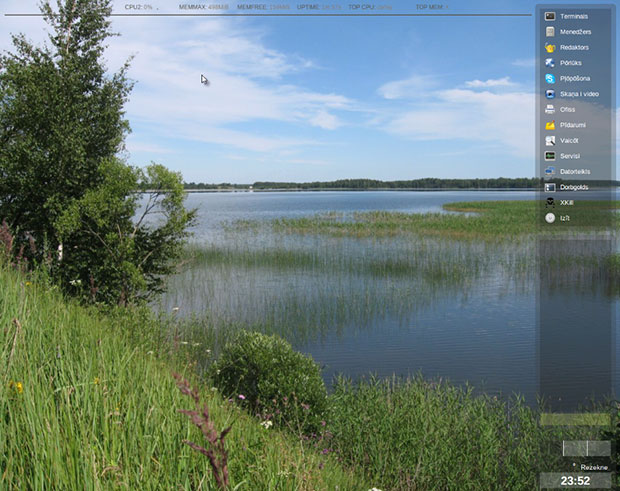
    For example, the default desktop look has a panel bar across the top of the screen and a transparent favorites panel anchored along the right edge of the screen. Right-click on the desktop to get a pop-up menu.

    This default view offers basic displays and menus. It has a virtual workspace switcher at the bottom of the favorites panel with three workspaces.

    Austrumi Linux's default desktop

    Austrumi Linux’s new default desktop is sparse, with a panel bar on top and a favorites bar along the right edge of the screen.


    Much of the desktop’s functionality is similar to using other really lightweight environments like Openbox and Xfce. However, FVWM is much less configurable and simpler to use.

    Click and Change

    With Austrumi Linux, you do not have to spend considerable time fiddling with style and theme configurations to change the look and feel. All you have to do is use the change option in system settings.

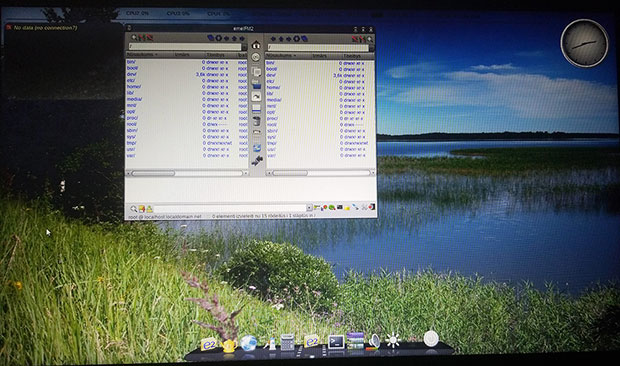
    It took a single click to morph the default desktop view into a more modern looking desktop with a MacOS-style dock at the bottom, and several docky-style applets on the desktop.

    In this setup, you no longer have the transparent panel hanging off the right edge of the screen. It is a much neater look.

    Austrumi Linux's System menu

    A single click within the System menu radically changes the desktop style in the latest release of Austrumi Linux.

    – click image to enlarge –


    Persistent Language Failure

    The problem with Austrumi is the same issue that existed in my initial hands-on review last year. The developers basically ignore language localization.

    If you speak Latvian, you will feel right at home. Other languages are available that include Russian, English, Greek, and a few more.

    But you cannot download a language-specific ISO to install the language of your choice. There is only one download file. Its default language is Latvian.

    I was hoping that this situation was updated with this latest upgrade release. It is not.

    If or when this problem is corrected, Austrumi Linux has the potential to gain far more notoriety than is provided by its limited exposure in central
    Europe. It’s really too bad the developers continue to ignore this language laziness legacy.

    Many of the features, along with the ease of use, makes this distro an option over more established and more popular Linux distros. How the developer team mishandles language localization in this distro removes most incentive for using Austrumi Linux unless, like me, you are a Linux distro-hopping nerd.

    Dare to Use It

    Austrumi booted straight into the Latvian language. Obviously, this is confusing. Those users who have a sense for the Linux OSes and how desktop menus work can make their way through the system to get a sense for how Austrumi works.

    I admit to being a language nerd of sorts. That, coupled with my familiarity with last year’s earlier version, became a puzzle-solving challenge. This latest release, however, was uniquely changed.

    The desktop design’s appearance was different. But the built-in language tool remained.

    To change the Latvian menus to English, click on the Top Menu label at the far right of the panel bar at the top of the screen. Then count down five Latvian words to the wrench and screwdriver (system) icon, and right-click it.

    Then select the last label in the list (flag icon-Voladyus) to open a short list of languages in a drop-down panel. The British Flag-English button is the first option here. No other English country option is available. Click it or another language of your choice.

    The screen reloads and Voila (that’s French), you still have mostly Latvian words visible in the right edge panel and across the top of the screen. The main system menus mostly display Latvian words.

    But when you launch individual icons to run an application, you see more use of English. At best, the use of localized language is a mixed bag.

    Disappointing Results

    The language localization is a big failure. It involves more than just messing up English. I used the language menu option to see if the other choices got rid of the Latvian vocabulary. They did not.

    This is a big disappointment. I experienced the same reaction a year ago when I first tried an earlier version of Austrumi Linux.

    The use of English was more prominent then, however. Perhaps this is because I downloaded an updated release months after the original upgrade circulated.

    I grabbed this latest release days after it became available. So, the language localization is probably a very hit-or-miss thing with this distro.

    Bottom Line

    Austrumi Linux contains all the necessary basic programs for work and entertainment. It boots from CD, flash drive or a hard drive installation and can be used on servers and workstations.

    Austrumi Linux is not well known, but it checks most of the usability boxes. The only technical requirement is the ability to burn the ISO to a DVD or USB.

    Do not expect much from the Austrumi web site. It is poorly designed and has no information about using the distro or getting help. Several of the pages are blank or not there.

    Beyond that process, just turn on the computer and use Austrumi. No installation is needed. Nor is there any need for system configurations.

    Of course, that all depends on whether Latvia is your native language.

    Want to Suggest a Review?

    Is there a Linux software application or distro you’d like to suggest for review? Something you love or would like to get to know?

    Please
    email your ideas to me, and I’ll consider them for a future Linux Picks and Pans column.

    And use the Reader Comments feature below to provide your input!


    Jack M. Germain has been an ECT News Network reporter since 2003. His main areas of focus are enterprise IT, Linux and open source technologies. He has written numerous reviews of Linux distros and other open source software.
    Email Jack.

  • Can a BBC reporter make better pizza than a machine?

    A machine which is able to put together about 300 pizzas per hour has been developed by Picnic.

    The dough base still has to be prepared by a human but the sauce and toppings are added by machine.

    Inside the machine are ingredient modules such as sauce, cheese, vegetables and meat.

    A camera takes pictures of each stage of the ingredients being added to the pizza which is then analysed by artificial intelligence software to help it improve the process.

    BBC Click’s Omar Mehtab finds out more.

    See more at Click’s website and @BBCClick

  • Facebook flaw let 5,000 developers gather personal data

    A small 3D-printed Facebook logo sits on a keyboard in this photo illustration

    Image copyright
    Reuters

    Facebook says it mistakenly let 5,000 developers gather information from people’s profiles after a time limit on their rights had expired.

    Apps on Facebook are supposed to be prevented from accessing people’s personal data if the app has not been used for 90 days.

    But Facebook said that lock-out had not always worked due to a flaw in how it recorded inactivity.

    “We fixed the issue the day after we found it,” the company said.

    Facebook has not stated how many users had their personal data scraped.

    The harvesting of Facebook users’ personal information by third-party apps was at the centre of the Cambridge Analytica privacy scandal that was exposed in 2018.

    Cambridge Analytica’s app on Facebook had harvested not only the data of people who interacted with it, but also that of friends who had not given consent. The company built a vast and lucrative database in the process.

    • The story of Cambridge Analytica
    • Zuckerberg pledges ‘privacy-focused’ Facebook

    Facebook’s chief executive Mark Zuckerberg faced questioning before the US Congress on how his company dealt with users’ personal information, and Facebook brought in its new policy on 90-day lock-outs for apps later that year.

    But Facebook now says the limit did not work properly.

    “Recently, we discovered that in some instances apps continued to receive the data that people had previously authorised, even if it appeared they hadn’t used the app in the last 90 days,” the company said in a statement.

    Policy change

    Facebook gave an example of the error in action. It said that if two Facebook friends had both used an app, and only one was still using it after 90 days, the app might gather personal information from the inactive friend.

    “For example, this could happen if someone used a fitness app to invite their friends from their home town to a workout, but we didn’t recognise that some of their friends had been inactive for many months,” the company said.

    In that example, the home town of a user would be the personal information in question. Facebook cited language and gender as other examples.

    The company said its estimate of 5,000 developers was only based on data available from the last few months.

    But it also said that the information handed out, even if it was after the time limit, was only what users gave permission for when they signed up to the app in the first place.

    In the same blog post, Facebook also announced that it was changing its platform terms and developer policies “to ensure businesses and developers clearly understand their responsibility to safeguard data and respect people’s privacy”.

    The faulty time limit in this announcement is the most recent in a long line of privacy issues for the social network.

    In November last year, a flaw in Facebook’s Groups feature was revealed. It allowed the harvesting of some personal data from groups.

    Figures announced in January showed that Facebook’s annual profit fell in 2019, for the first time five years – partly due to settlements with regulators over privacy concerns.

  • Google’s Fitbit takeover probed by EU regulators

    Fitbit next to Google logo

    Image copyright
    Reuters

    The EU is questioning whether Google’s proposed takeover of Fitbit will harm competition, or give it access to too much personal data.

    Fitbit makes fitness-tracking watches that monitor the wearer’s heart rate and activity levels.

    A group of 20 consumer groups and privacy advocates have called for Google’s takeover to be blocked.

    Google said it would not use Fitbit data to target advertising and would be “transparent” about the data gathered.

    It announced it was buying loss-making Fitbit for $2.1bn (£1.68bn) in November 2019.

    The move would help Google expand its wearables business and offer its own-brand smart watches to rival the Apple Watch.

    ‘Intimate information’

    But some are concerned that Google already has a wealth of personal information about many people who use its products.

    As part of its campaign opposing the takeover, Privacy International said: “We don’t think any company should be allowed to accumulate this much intimate information about you.”

    EU regulators will decide by 20 July whether to allow the deal or launch an investigation.

    They have sent detailed questionnaires to several of Google and Fitbit’s rivals, asking whether the takeover will put them at a disadvantage.

    Australia’s competition authority has also said it may have concerns about the deal,and will make a decision in August.

    “This deal is about devices, not data,” Google told Reuters news agency.

    “We believe the combination of Google’s and Fitbit’s hardware efforts will increase competition in the sector.”

  • PS5 and Xbox Series X: Video game NBA 2K21 to cost more on new consoles

    NBA 2K21 next to an Xbox Series X and PS5

    Image copyright
    Microsoft/2K Games/Sony

    Games publisher 2K will charge £5 more for its forthcoming NBA 2K21 basketball game on the PlayStation 5 and Xbox Series X consoles.

    It is the first company to reveal how it will price software for the next-generation machines.

    Sony and Microsoft have yet to reveal how much they plan to charge for the new hardware.

    One analyst said it was not unusual for new console games to be priced at a premium.

    But it is an added factor for gamers to consider at a time when finances are under strain because of the coronavirus pandemic.

    “It is commonplace for games on new platforms to cost more than the older platforms, but the situation is made more complex because of backwards compatibility on Xbox Series X and PS5,” Piers Harding-Rolls from the, Ampere Analysis consultancy, told the BBC.

    While 2K publishes recommended prices, retailers may decide to charge different amounts for the game.

    Compatibility

    Sony and Microsoft have both made compatibility pledges for their new consoles.

    Sony has announced that dozens of popular PS4 games, including the 100 most played, will work on the PS5.

    Microsoft is promoting its “smart delivery” initiative, which lets players buy a game once and use it on any of its Xbox One or Series X consoles. It also has a “play anywhere” scheme that lets players access a purchased game on both an Xbox console and a Windows PC.

    2K Games told the BBC the title was not part of the “play anywhere” scheme.

    NBA 2K21 will be a launch title for both the PlayStation 5 and Xbox Series X, which are expected to go on sale in time for Christmas.

    The edition for existing machines will be released on 4 September.

    The standard version of the game will cost the same regardless of whether a player buys a physical disc or a digital download:

    • £49.99 on the Nintendo Switch
    • £59.99 on PlayStation 4 or Xbox One ($59.99 in the US)
    • £64.99 on PlayStation 5 or Xbox Series X ($69.99 in the US)

    Next-generation

    2K said the game had been “built from the ground up for next-generation consoles”, but has not yet said how it will differ between the two generations.

    “We believe our suggested retail price for NBA 2K21 on next-generation platforms fairly represents the value of what’s being offered: power, speed and technology that is only possible on new hardware,” the company told the BBC.

    “Making games is an expensive business and production costs continue to escalate, so I can see why publishers want to charge more for enhancements on the new consoles,” said Mr Harding-Rolls.

    “However, with Microsoft pushing its smart delivery strategy and third parties following their own policies, the situation is becoming unnecessarily complex for gamers.”

    A deluxe version of the sports simulator – called Mamba Forever – will celebrate the lifetime achievement of NBA legend Kobe Bryant, who died in 2020.

    It will cost:

    • £84.99 on both the current and next-generation console ($99.99 in the US)
    • £79.99 on PC
    • £79.99 on Google Stadia

    2K has it said it will:

    • give players who buy the deluxe version on PS4 or Xbox One access to the standard version of the game on PS5 or Xbox Series X
    • give players who buy the deluxe version on PS5 or Xbox Series One access to the standard version of the game on PS4 or Xbox One
    • introduce “initiatives to bridge the two versions of the game”, including a shared virtual currency wallet within the same console family.
  • Top tips for making sure what you’re seeing online is legitimate

    Members of the BBC’s anti-disinformation team offer insider tips on how to verify photos and videos online – so that you can be sure that what you’re seeing is reliable.

    Video journalist: Paul Brown

    Presenters: Shayan Sardarizadeh, Reha Kansara and Benjamin Strick

    Follow BBC Trending on Twitter @BBCtrending or on Facebook.

  • Finding the ‘invisible’ millions who are not on maps

    Rural home about 70 kilometres south of the Rwandan capital Kigali

    Image copyright
    Getty Images

    Image caption

    There are often no maps of rural areas of Rwanda

    “There are about two billion people in the world who don’t appear on a proper map,” says Ivan Gayton from the charity Humanitarian OpenStreetMap.

    “It’s shameful that we – as cartographers of the world – don’t take enough interest to even know where they are. People are living and dying without appearing on any database.”

    Known as the “Wikipedia for maps”, anyone can download OpenStreetMap and edit it too.

    “It’s an amazing situation where anyone could wreck it, anyone can add to it, but what we’ve ended up with is a map that is the most up-to-date in some places.”

    According to Mr Gayton, it is the most complete and accurate map for many parts of the world, especially in rural Africa, where underinvestment means, outside of cities, there are often blank pages where millions live.

    Image copyright
    Ivan Gayton

    Image caption

    Ivan Gayton believes better data will solve critical healthcare issues

    As we sit in Rwanda, Mr Gayton gestures into the distance: “It’s not very far from here, over in the Democratic Republic of Congo just across the border, where the information all but stops. It’s not like people don’t live there, they just aren’t recorded.”

    So why does it matter?

    Mr Gayton says it can be a matter of life and death. “If you take an outbreak of disease like Ebola or the new coronavirus, contact tracing is how you stop epidemics. It’s not the treatment, it’s the public health and map data that makes it possible.”

    He worked on mapping efforts during the West Africa Ebola outbreak of 2014-15, and found a lack of data caused critical problems in locating disease hotspots.

    “If you come into a health facility anywhere in the world with a communicable disease, they’ll ask you where you’re from. In the low-income world you don’t always have a system for describing that location.”

    Image copyright
    Ivan Gayton

    Image caption

    Health workers at an Ebola treatment facility in Sierra Leone

    This is something that Liz Hughes, chief executive of Map Action, is passionate about too. Her organisation helps provide maps for aid agencies and governments, using both technology and volunteers.

    She cites examples such as flooding, where up-to-date maps are needed urgently. “We can work out where the most critical need is, and then aid can be better targeted in a natural disaster or epidemic situation.”

    The big technology firms have invested huge amounts into their mapping efforts, but Ivan Gayton says there is a clear gulf in terms of priority.

    “There isn’t much commercial incentive for Google to identify the nearest Starbucks in the Democratic Republic of Congo,” he says.

    Maps are the building blocks of economic development. Without accurate maps it’s not just navigating from A to B that can be difficult – the essential tasks of proper planning for housing and infrastructure can be impossible.

    Image copyright
    Rumani Huria

    Image caption

    Dar es Salaam is rapidly urbanising

    The World Bank’s Edward Anderson has worked on mapping efforts for the last decade, first in the Pacific, and now in Africa. He says that traditionally, maps were done at a national level, and it could take years between a survey and the production and application of the map.

    “Cities are especially a problem, because we are seeing very rapid urbanisation, and the fastest rate of unplanned urbanisation in history. Around 80% of the growth in urban areas is unplanned, and 70% of new residents in cities are entering slums.

    “Quite often the maps city planners have to use are 10 years old.”

    This means, he says, that authorities are always playing catch-up.

    One of those capitalising on the need for mapping is Tanzanian entrepreneur Freddie Mbuya. Mining companies pay him to map their land using drones. This kind of detailed mapping needs to be done frequently, often in areas that are hard to reach.

    Image copyright
    African Drone Forum

    Image caption

    Land is key to fighting poverty but we can’t do this if we don’t know where the land is, says Freddie Mbuya

    He says global technology companies don’t have the incentive to map to a local scale in rural Africa, which would be time-consuming and costly.

    “Google and Apple maps do not differentiate between a good road and a bad road – but that’s so important,” he says.

    Mr Mbuya adds that land titling is also critical for development.

    “Land is the key to fighting poverty. But how can we do this if we don’t know where our land is? If the land isn’t titled we cannot leverage the value of our land. Most of my family land has been lost or is not being developed – we need land to be surveyed and formalised…. so we can go to a bank and get a loan with a piece of paper saying I own this land.”

    More Technology of Business

    Scottish geographer Paul Georgie is the founder of mapping company Geo Geo.

    He says in today’s digital society, not being on a map is akin to being invisible. “Even just having your house or your hut or your village on a map, with the associated roads, is vital for the government to help with planning.”

    He worked on a project in Tanzania setting up energy grids in remote communities.

    Image copyright
    Map Action

    Image caption

    Liz Hughes says maps are often needed instantly after disasters

    “We downloaded rough satellite images and took them into villages. Maps speak a universal language and people were able to label the pictures. Formalising this, mapping it and making it tangible gives people a larger voice around the world.”

    Labelling and filling in the blanks is also being done by volunteers around the world.

    Liz Hughes from Map Action explains: “In places like Sierra Leone, while we were working on the Ebola response, we couldn’t even find maps to show where the roads were, and out of that was born the Missing Maps.”

    Once a month in cities like London and New York, enthusiasts get together to work on these maps, using open data and volunteer contributions to help fill in the blanks online.

    Image copyright
    Chris Morgan

    Image caption

    A volunteer mapper in Dar es Salaam

    Map Action also works to train volunteers on location.

    “We train people in knowing what might be needed on the ground. An example would be Ebola in Sierra Leone. We worked with the UK’s health adviser to work out where would be best to put water points for handwashing,” says Ms Hughes.

    Volunteers are used in community projects across Africa, including in Dar es Salaam, Tanzania’s rapidly urbanising commercial hub.

    Here student volunteers for a project called Ramani Huria map using simple apps on smartphones in the many unplanned areas where drainage and flooding are frequent and deadly issues. These help local authorities trace where cholera outbreaks may occur in clusters.

    The World Bank’s Edward Anderson says that community-led mapping gives valuable immediacy to the information.

    “We need to update the data on a yearly or quarterly basis, in a bottom-up way. Nearly every urban adult has access to a smartphone now. So we can use this community-collected data to really update our knowledge of the informal areas.

    “They’re unplanned, but clearly people know their own names for streets and where the water points and communal toilets are, they’re just not on any map.”

    Image copyright
    Map Action

    Image caption

    Mappers creating up-to-date information

    But Ivan Gayton acknowledges that the public health argument for comprehensive mapping doesn’t convince everyone. It will, he says, be an economic incentive that wins over cynics.

    “The most compelling use case for the average person is to get a pizza or order a cab. My belief is that as the technology makes it possible for people not to have to spend half a day working out where their driver is, they will do it. People want to do business.”

  • Coronavirus: A lockdown journey from couch to kettlebells

    Zoe Kleinman and kettlebell

    Of all the roles life has carved out for me, this one has to be one of the most unexpected.

    But sharing my DIY lockdown kettlebell regime on social media, primarily for the purposes of self-motivation, has resulted in an avalanche of requests for help and support for others – mainly women – wanting to do the same.

    My most recent picture, shared after eight weeks of almost (ahem) daily 20-minute workouts, had nearly 100,000 views and resulted in a very funny pitch from a fitness company wanting this 40-something BBC tech reporter to become a brand ambassador.

    I’m not about to give up the day job, but it was a flattering – though undoubtedly misguided – gesture.

    Kettlebells are rounded weights that look a bit like a cannonball but with a handle. They date back to the 17th Century, but you may have found them a little harder to come by recently as demand in lockdown has soared.

    Image copyright
    Getty Images

    Image caption

    German strong-man Eugene Sandow (1867 – 1925) pictured with weights and an early form of kettlebell at his feet

    Online searches for them in the UK practically doubled from 2.1 million in March to 4.1 million in May, according to Redbrain, an e-commerce platform with access to the data of millions of shopping searches and how they translate into sales.

    At the beginning of March, I’d already had a set for several months – despite my best intentions I’d just never got round to using them.

    When lockdown hit, I realised that I suddenly had an extra three hours in my working day that wasn’t taken up by the commute – and that I was spending more time than ever sitting far too close to the snack cupboard at home.

    However, also within reach were my dusty kettlebells, which had been deployed as doorstops.

    I had absolutely no idea what to do with them.

    Fortunately, there are plenty of people out there who do – Google “kettlebell workout” and you’ll get around 34.5 million results.

    I started clicking through them. Lots of them. Many did not hold my attention for very long. The workouts were too long, too fast, too painful – my 40-year-old joints wouldn’t cope with that, how on Earth am I supposed to hold that there? And so on.

    However, I also began to spot emerging themes in the exercises and I gained an understanding of which ones were best for achieving what I wanted: core strength.

    Image copyright
    Worthy Photography

    Image caption

    FitState founders Emma McCaffrey, Zoe Baker and Viki Potter have found a new audience online

    Slowly, I built myself a workout based on those elements – adding some extra ones along the way as people started to contact me and share their own favourites (I’m not sure whether to be grateful for the recent addition of Russian twists, which are as painful as they sound).

    While the online fitness industry has rocketed during lockdown, for some more traditional businesses it’s meant a very dramatic change.

    Personal trainers Emma McCaffrey, Zoe Baker and Viki Potter found themselves having to rethink their entire business model of outdoor classes for a core market of 35-50-year-old women practically overnight.

    With Emma and Zoe based in Winchester and Viki in Wimbledon, their business, FitState, had been local to those two areas.

    Since switching their classes to invitation-only Zooms, women from Wales, Bristol, Newcastle and the south of France have joined in.

    “I don’t think I’d really heard of Zoom, and suddenly we had 10 classes scheduled,” said Zoe, recalling the start of lockdown.

    After much trial and error, the trio have settled on a format that works. Clients don’t have to use the camera if they would rather not, and everyone apart from the instructor is on mute throughout.

    “We don’t have music – it just doesn’t work,” says Emma. “It’s clunky, tinny and people can’t hear you.”

    It’s also not the easiest way to teach and, of course, any feedback about technique or posture is impossible.

    “When you’re teaching online there’s no banter, it’s straight down to business. As the teacher, you are doing every exercise, keeping up the pace, keeping time, talking, breathing and keeping the tech going,” says Emma.

    However, the format has become so successful that they now plan to keep offering Zoom classes despite the loosening of lockdown rules.

    “Zoom’s not the same as face-to-face but it does feel like we’re all together,” says Emma. “It doesn’t necessarily work better but we are finding that people are more likely to commit to it, and it’s enabled people from all around the country to join us.”

    Image copyright
    Colin Howells

    Image caption

    Kettlebell instructor Colin Howells

    Colin Howells, a martial arts and advanced kettlebell instructor at Gym01 in Portsmouth, has decided to wait until the gym is able to reopen before he resumes coaching, face-to-face.

    He does however have some advice for those of us picking up kettlebells for the first time.

    According to him, the most common mistake beginners make is having the wrong posture.

    Bending your back during the famous kettlebell swing move – where you swing the bell holding on to the handle with both hands from between your knees to shoulder height and back down again – can cause injury.

    “You’ll know if you’re doing it wrong because one area of your body will feel sore and the rest won’t,” he says. “You’re using eight muscle groups – there’s no intense impact, you’re letting gravity do the work. You shouldn’t feel sore afterwards.”

    He also says it’s important to choose the right weight and not to start out too light.

    “On average, women start with a kettlebell weighing between 10 and 12kg (22-26lbs); 16kg (35lbs) for men,” he says. “You’ll never get the technique right if you don’t have the correct weight.

    “Make sure you keep your spine straight when you’re swinging the kettlebell. Squat, with your feet about shoulder-width apart, put your weight on your heels, shoulders relaxed and back.”

    Although you gain a lot of momentum during the swing itself, try not to swing the bell above shoulder height, he adds.

    “Always do a little pre-swing – gently, just between your legs, before you start, to minimise injury risk,” Colin says.

    He also advises changing the exercises around every few weeks.

    “It’s a really good exercise and really enjoyable,” he says. “You could start to see results in a month if you stick to it.”

    When people first get into it, they realise they can shift the weight around easily and sometimes get a bit carried away,” he adds.

    “Keep it simple to start with.”

    As for me, well, I’m not planning a new career as a fitness guru. In fact, I’m looking forward to the day when a professional can actually watch me and tell me how I can continue to improve.

    I think I’m on the right lines though because this week I managed to do a handstand for the first time in 30 years.

    Yes, I was showing off in front of my children, but I would not have been able to do that in the days when I was on the early train to work, and those kettlebells propped open the door to the lounge.