Category: iT news

  • Halo Infinite Xbox Series X trailer divides fans

    Media playback is unsupported on your device

    Media captionWATCH: First look at Halo Infinite

    Microsoft has given gamers a first look at Halo Infinite’s gameplay.

    The firm said that the game’s map was more than twice the size of that in the sci-fi franchise’s last two entries combined.

    It also promised “more complex visual effects” than before on its forthcoming Xbox Series X console.

    However, some gamers voiced disappointment on social media at the quality of the graphics shown within the demo.

    Image copyright
    Microsoft

    Image caption

    Halo Infinite’s trailer featured an action-packed battle before revealing the game’s wider plot

    This may in part be down to the art style of Halo Infinite, and the live stream being broadcast in high definition at 1080p.

    A trailer uploaded soon afterwards in 4K showed the detail and lighting to much better effect.

    Image copyright
    Twitter

    There was a more positive response to the addition of new weapons, which included a grappling hook as well as a futuristic automatic pistol.

    Microsoft is also promoting the game’s fast-loading times on the new console – a feature Sony also made much of at its recent PlayStation 5 event.

    Image copyright
    Microsoft

    Image caption

    Microsoft said Halo Infinite would run at 60 frames per second on the Xbox Series X

    “There’s a huge community around Halo, people really love Master Chief, but it also reaches a wider audience with people who may not finish the story, but spend hours in multiplayer,” commented Ellen Rose, presenter of the Outside Xtra gaming show.

    “If Xbox nails it, it could really help shift sales of the new Xbox Series X.”

    Microsoft also confirmed another of its big name franchises would come to the new console in the form of Forza Motorsport 8.

    Image copyright
    Microsoft

    It was described as being in the early stages of its development, so is unlikely to be released alongside the device.

    Other games unveiled included:

    • Hellblade 2: Senua’s Saga – a sequel to the Bafta-winning original, which will be set in Iceland this time round
    • Grounded – a third-person action game in which the player’s character has been shrunk and must fight insects in their backyard
    • State of Decay 3 – a second sequel to the survival horror game, which featured a zombie deer in its trailer

    Image copyright
    Microsoft

    Image caption

    Hellblade’s protagonist is a Celtic warrior who deals with psychosis – the first game was praised for its handling of her mental health issues

    Microsoft also showcased Tell Me Why from France’s Dontnod Entertainment studio, which previously released Life Is Strange.

    It is notable for featuring what the developers have said is the first playable transgender lead in a major release.

    The trailer showed Tyler and his twin sister Alyson seeing ghosts of their past selves in a story that centres on exploring mysteries about their mother and childhood.

    Despite the decision to break new ground, the footage shown did not make specific mention of Tyler’s gender identity.

    Image copyright
    Microsoft

    Image caption

    Tell Me Why is a narrative adventure game that will be released in several chapters

    Over the current generation of games machines, the Xbox One comes third in terms of global sales, behind Sony’s PlayStation 4 and Nintendo’s Switch.

    But one expert said it had fared much better in terms of market share in the UK.

    “There’s a love for the Halo brand among UK consumers, and their tastes are generally more aligned with the US [where the gap is also closer],” commented Piers Harding-Rolls from Ampere Analysis.

    “So, I expect it to be pretty close between the two next-generation platforms here. But when you look at continental Europe and other global markets, the disparity is likely to be significantly in the PlayStation 5’s favour.”

    Both Sony and Microsoft have invested in exclusive content by acquiring third-party games studios in recent years.

    However, they are now pursuing different strategies.

    Sony plans to release several of its new games only on the PlayStation 5. By contrast, Microsoft generally intends to launch its forthcoming first-party titles on both PCs and the new Xbox Series X, and often the existing Xbox One as well.

    As yet, neither company has revealed how much their new consoles will cost, despite both being set to go on sale before the end of 2020.

    They may both be holding off in the hope the other will go first, allowing the second party to tweak their strategy accordingly.

    However, Mr Harding-Rolls suggested the companies would be wise not to wait for too long,

    “The coronavirus has created pressure on spending, so I think there would be an advantage to giving people the ability to pre-order,” he said.

    ‘A firmer footing’

    Analysis by Marc Cieslak, BBC Click

    Image copyright
    Microsoft

    What is the next generation all about, beyond better graphics and speedy loading times?

    It’s a question I’ve been asking to every developer and games industry executive I’ve spoken to for the last year.

    So far, I’m yet to receive a response that fully answers the question.

    After a shaky first showcase from Xbox back in May, calling in back-up from Halo’s Master Chief at this latest event put the Series X console on a firmer footing.

    In comparison to Sony’s online shock-and-awe showing last month, Xbox opted for a slick and classy event. Halo Infinite and Forza Motorsport used tried and tested Xbox franchises to demonstrate the new machine will be a force to be reckoned with.

    To me, this event was far more reminiscent of the atmosphere and feel of Xbox’s recent E3 showcases.

    A grown-up affair, which highlighted a wide diversity of games from crowd-pleasing first-person shooters and racing titles to more thoughtful fare like Tell Me Why, a platform-exclusive game with a trans lead character. They even found time to tease a new Fable too.

    Image copyright
    Microsoft

    Image caption

    The new Fable trailer showed a fairy taking an exhilarating flight before being eaten by a toad

    It looks like Xbox is more than ready for the challenge of yet another scrap with PlayStation.

    But consumer expectation for the next-generation’s capabilities should probably be tempered, until we get a first hand look at games playing on next-gen machines, rather than making a judgement based on an online promo stream.


  • Blackbaud Hack: Universities lose data to ransomware attack

    University of York

    Image copyright
    Getty Images

    Image caption

    The University of York is one of those institutions affected

    At least seven universities in the UK and Canada have had student data stolen after hackers attacked a cloud computing provider.

    Human Rights Watch and the children’s mental health charity, Young Minds, have also confirmed they were affected.

    The hack targeted Blackbaud, one of the world’s largest providers of education administration, fundraising, and financial management software.

    The US-based company’s systems were hacked in May.

    It has been criticised for not disclosing this externally until July and for having paid the hackers an undisclosed ransom.

    The institutions the BBC has confirmed have been affected are:

    • University of York
    • Oxford Brookes University
    • Loughborough University
    • University of Leeds
    • University of London
    • University of Reading
    • Ambrose University in Alberta, Canada
    • Human Rights Watch
    • Young Minds
    • Rhode Island School of Design in the US

    All the institutions are sending letters and emails apologising to affected staff, students, alumni and donors.

    In some cases, the stolen data included phone numbers, donation history and events attended. Credit card and other payment details do not appear to have been exposed.

    Blackbaud, whose headquarters are based in South Carolina, declined to provide a complete lists of those impacted, saying it wanted to “respect the privacy of our customers”.

    “The majority of our customers were not part of this incident,” the company claimed.

    It referred the BBC to a statement on its website: “In May of 2020, we discovered and stopped a ransomware attack. Prior to our locking the cyber-criminal out, the cyber-criminal removed a copy of a subset of data from our self-hosted environment.”

    The statement goes on to say Blackbaud paid the ransom demand. Doing so is not illegal, but goes against the advice of numerous law enforcement agencies, including the FBI, NCA and Europol.

    Blackbaud added that it had been given “confirmation that the copy [of data] they removed had been destroyed”.

    Several Blackbaud clients listed on its site have confirmed they were not affected, including:

    • University of Oxford
    • University College London
    • Queen’s University Belfast
    • University of the West of Scotland
    • Islamic Relief
    • Prevent Breast Cancer

    “My main concern is how reassuring – impossibly so, in my opinion – Blackbaud were to the university about what the hackers have obtained,” commented Rhys Morgan, a cyber-security specialist and former student at Reading University, whose data was involved.

    “They told my university that there is ‘no reason to believe that the stolen data was or will be misused’.

    “I can’t feel reassured by this at all. How can they possibly know what the attackers will do with that information?”

    Image copyright
    Getty Images

    Image caption

    Oxford Brookes University is among those contacting students about the hack

    Blackbaud has said it is working with law enforcement and third party investigators to monitor whether or not the data is being circulated or sold on the dark web, for example.

    Barrister blogger Matthew Scott was also sent an email about the hack.

    “I doubt that my university has many details that aren’t pretty easily available, but I am more concerned about giving in to the blackmail and blithely accepting the word of the blackmailer that all the data has now been destroyed,” he told the BBC.

    Privacy law

    Under General Data Protection Regulation (GDPR), companies must report a significant breach to data authorities within 72 hours of learning of an incident – or face potential fines.

    The UK’s Information Commissioner’s Office [ICO], as well as the Canadian data authorities, were informed about the breach last weekend – weeks after Blackbaud discovered the hack.

    An ICO spokeswoman said: “Blackbaud has reported an incident affecting multiple data controllers to the ICO. We will be making enquiries to both Blackbaud and the respective controllers, and encourage all affected controllers to evaluate whether they need to report the incident to the ICO individually.”

    Leeds University said, in a statement: “We want to reassure our alumni that, since being informed by Blackbaud of this incident, we have been working tirelessly to investigate what has happened, in order to accurately inform those affected. No action is required by our alumni community at this time, although, as ever, we recommend that everyone remains vigilant.”

  • Apple co-founder sues YouTube over Bitcoin scam

    Steve Wozniak

    Image copyright
    Getty Images

    Image caption

    Steve Wozniak questions whether YouTube’s algorithms are dealing with scams

    Apple co-founder Steve Wozniak is suing YouTube for allegedly allowing scammers to use images and videos of him to defraud people.

    The scam, similar to one used in a Twitter hack, requested people send cryptocurrency, falsely promising they would receive twice as much back.

    Mr Wozniak accused YouTube of failing to deal with the problem.

    YouTube and Google have been contacted for comment but have not yet responded.

    Criminal activity

    The complaint alleges the “vast” scam is continuing on YouTube, with tens of millions of dollars in cryptocurrency stolen.

    As well as Mr Wozniak, the law firm Cotchett, Pitre and McCarthy is also representing 17 others affected by the fraud, from the US, UK, Canada, Japan, Malaysia, China and Europe.

    In a statement, Mr Wozniak said: “If YouTube had acted quickly to stop this to a reasonable extent, we would not be here now.

    “YouTube, like Google, seems to rely on algorithms and no special effort requiring custom software employed quickly in these cases of criminal activity.

    “If a crime is being committed, you must be able to reach humans capable of stopping it.”

    ‘Massive hack’

    It is hard to estimate how widespread such scams are.

    But last month, fraudsters stole at least $150,000 (£117,000) by impersonating Elon Musk’s Space X YouTube channel and hosting a live-streamed event asking viewers to send Bitcoin.

    And a report from cryptocurrency monitoring service Whale Alert suggested scammers made $24m in Bitcoin during the first six months of 2020.

    Lawyer Joe Cotchett. who is representing Mr Wozniak, compared the YouTube scam to the recent Twitter hack.

    “When Twitter was hit with a massive hack of 130 celebrity accounts, they were quick to shut down the Bitcoin scam in a day,” he said.

    “In stark contrast, the complaint alleges that YouTube knowingly allowed the Bitcoin scam to go on for months promoted it and profited from it by selling targeted advertising.”

    In a similar case brought by cryptocurrency company Ripple Labs, YouTube’s legal team successfully argued the platform was not liable for any content – including scams – provided by third parties.

  • Twitter says hackers viewed 36 accounts’ private messages

    Twitter padlock

    Image copyright
    Getty Images

    Twitter has revealed that hackers viewed private direct messages (DMs) from 36 of the accounts involved in last week’s hack.

    It has not disclosed who they belonged to beyond saying one was owned by an elected official in the Netherlands.

    Twitter added that it does not believe any other former or current politicians had their DMs accessed.

    It is not clear how many of the accounts overlap with the 45 that tweeted a Bitcoin scam.

    Although Twitter has not named the Dutch official affected, local reports have indicated it is likely the far-right politician Geert Wilders.

    Last week, his profile image was replaced with that of a cartoon of a black man, and his account’s background image was changed to that of the Moroccan flag.

    Calls to testify

    On 16 July, the accounts of several high profile business leaders, celebrities and politicians accounts posted a bogus get-rich-quick scheme, including:

    • Amazon’s founder Jeff Bezos
    • Tesla’s chief Elon Musk
    • the rapper Kanye West
    • the reality-TV star Kim Kardashian West
    • former US President Barack Obama
    • the Democratic presidential candidate Joe Biden

    It is believed victims sent about $120,000 (£93,600) in Bitcoin to the perpetrators, and the sum would have been larger if a crypto-currency exchange had not blocked further transfers.

    Twitter has said a total of 130 accounts were targeted in the attack, which exposed personal information including email addresses and telephone numbers.

    It previously revealed that eight non-verified accounts had all of their Twitter data downloaded, including DMs. The firm has not said if any of these coincide with the ones whose DM inboxes were looked at.

    The social network may reveal more about the incident when it posts its latest financial results before the bell this Thursday.

    The US Senate Commerce Committee has also demanded Twitter brief it about the wider incident by 23 July.

    The senior Republican on the House of Representatives’ Judiciary committee has also called on its chair to ask Twitter’s chief executive Jack Dorsey to attend a separate hearing on Monday, at which Facebook, Apple, Google and Amazon’s chief executives are already scheduled to give testimony.

    However, political watchers say it is unlikely that a formal invitation will be made as the focus of that event is anti-competitive behaviour, and Twitter is a much smaller company than the others.

  • China’s Tianwen-1 Mars rover rockets away from Earth

    Mars launch Long March 5

    Image copyright
    AFP

    Image caption

    China’s big Long March 5 rocket sent the Tianwen-1 mission on its way

    China has launched its first rover mission to Mars.

    The six-wheeled robot, encapsulated in a protective probe, was lifted off Earth by a Long March 5 rocket from the Wenchang spaceport on Hainan Island at 12:40 local time (04:40 GMT).

    It should arrive in orbit around the Red Planet in February.

    Called Tianwen-1, or “Questions to Heaven”, the rover won’t actually try to land on the surface for a further two to three months.

    This wait-and-see strategy was used successfully by the American Viking landers in the 1970s. It will allow engineers to assess the atmospheric conditions on Mars before attempting what will be a hazardous descent.

    Tianwen-1 is one of three missions setting off to Mars in the space of 11 days.

    On Monday, the United Arab Emirates (UAE) launched its Hope satellite towards the Red Planet. And in a week from now, the US space agency (Nasa) aims to despatch its next-generation rover, Perseverance.

    Image copyright
    Reuters

    Image caption

    A model of the rover shows it to have a similar look to Nasa’s Spirit and Opportunity vehicles

    The targeted touchdown location for the Chinese mission will be a flat plain within the Utopia impact basin just north of Mars’ equator. The rover will study the region’s geology – at, and just below, the surface.

    Tianwen-1 looks a lot like Nasa’s Spirit and Opportunity rovers from the 2000s. It weighs some 240kg and is powered by fold-out solar panels.

    A tall mast carries cameras to take pictures and aid navigation; five additional instruments will help assess the mineralogy of local rocks and look for any water-ice.

    This surface investigation is really only half the mission, however, because the cruise ship that is shepherding the rover to Mars will also study the planet from orbit, using a suite of seven remote-sensing instruments.

    Image copyright
    NASA-JPL

    Image caption

    Nasa’s 1976 Viking-2 mission also landed on Utopia Planitia

    The historic statistics for the exploration of the Red Planet are well known: about a half of all ventures have failed. Indeed, China’s first effort to send a satellite, Yinghuo-1, to the dusty world stalled in Earth orbit when its Russian carrier stage failed and fell back towards the Pacific Ocean.

    So far, only the Americans have managed to run long-lived operations on Mars (the Soviets’ Mars-3 and Europe’s Beagle-2 missions got down but failed shortly after).

    China, however, can take confidence from the successes of its two recent Chang’e Yutu lunar rovers, the second of which made the first ever soft landing on the far side of the Moon last year.

    The country’s engineers will believe they are now ready to tackle the infamous “seven minutes of terror” – the time it takes for a spacecraft to make the perilous trip from the top of Mars’ atmosphere to the ground.

    Media playback is unsupported on your device

    Media captionHow long does it take to get to Mars and why is it so difficult?

    “Entering, deceleration and landing (EDL) is a very difficult (process). We believe China’s EDL process can still be successful, and the spacecraft can land safely,” mission spokesperson Liu Tongjie was quoted as saying ahead of launch by the Reuters news agency.

    Tianwen-1 will use a combination of a capsule, parachute and a retro-rocket to burn off entry speed and slow itself to a stop right at the surface. If all goes well, the landing mechanism will then deploy a ramp to enable the rover to begin its traverse across the Martian plain.

    Chinese scientists would like to get at least 90 Martian days of service out of the robot. A day, or Sol, on Mars lasts 24 hours and 39 minutes.

    “It’s incredibly exciting to see what China is doing,” observed Dr Rain Irshad, autonomous systems leader at RAL Space in the UK.

    “Their space agency was only formed in 1993, and yet here they are, less than 30 years later, sending an orbiter, a lander and a rover to Mars.

    “But they put themselves through a training programme with their Chang’e missions at the Moon. It’s very impressive the way they’ve been banging out the lunar missions one after the other.”

  • Premier League club almost lost £1m to hackers – report

    NCSC said its report found hackers were trying to compromise sporting organisations on a daily basis, often by targeting business email

    A Premier League club came close to losing £1 million during a transfer deal due to cyber hackers.

    The National Cyber Security Centre (NCSC) said it was only the intervention of the unnamed club’s bank that stopped the theft.

    It was one of several incidents highlighted as evidence that sport needed to improve its cybersecurity.

    “The impact of cybercriminals cashing in on this industry is very real,” said the NCSC’s Paul Chichester.

    A new report from the NCSC says the email address of a Premier League club’s managing director had been hacked during a transfer negotiation, leading to the attempt to steal the £1 million.

    The report also says that a Football League club was targeted by hackers who cut off its security systems, blocking turnstiles and almost resulting in a fixture postponement.

    And it added that in one incident a member of staff at a racecourse lost £15,000 after attempting to buy groundskeeping equipment from a fake version of eBay.

    Sir Hugh Robertson, chair of the British Olympic Association, said in the report: “This report is a crucial first step, helping sports organisations to better understand the threat and highlighting practical steps that organisation should take to improve cybersecurity practices.”

  • QAnon: What is it and where did it come from?

    Man poses with a Q sign at a Trump rally

    Image copyright
    Getty Images

    Twitter has announced a crackdown on the QAnon conspiracy theory, banning thousands of accounts and blocking web addresses linking to videos and websites spreading QAnon’s bizarre ideas.

    It’s a fringe movement but one that has picked up a tremendous head of steam online, particularly in the United States.

    So what is QAnon and who believes in it?

    What is it?

    At its heart, QAnon is a wide-ranging, unfounded conspiracy theory that says that Donald Trump is waging a secret war against elite Satan-worshipping paedophiles in government, business and the media.

    QAnon believers have speculated that this fight will lead to a day of reckoning where prominent people such as Hillary Clinton will be arrested and executed.

    That’s the basic story, but there are so many offshoots, detours and internal debates that the total list of QAnon claims is enormous – and often contradictory. Adherents draw in news events, historical facts and numerology to develop their own far-fetched conclusions.

    • QAnon: What’s the truth behind a pro-Trump conspiracy theory?

    Where did it all start?

    In October 2017, an anonymous user put a series of posts on the message board 4chan. The user signed off as “Q” and claimed to have a level of US security approval known as “Q clearance”.

    These messages became known as “Q drops” or “breadcrumbs”, often written in cryptic language peppered with slogans, pledges and pro-Trump themes.

    • Twitter cracks down on QAnon conspiracy theorists

    Image caption

    “Where we go one we go all”, often abbreviated as “WWG1WGA!” is one of the most popular QAnon slogans

    Nobody actually believes it, right?

    Actually, thousands do. The amount of traffic to mainstream social networking sites like Facebook, Twitter, Reddit and YouTube has exploded since 2017, and indications are the numbers have gone up further during the coronavirus pandemic.

    Judging by social media, there are hundreds of thousands of people who believe in at least some of the bizarre theories offered up by QAnon.

    And its popularity hasn’t been diminished by events which would seem to debunk the whole thing. For instance, early Q drops focused on the investigation by special prosecutor Robert Mueller.

    QAnon supporters claimed Mr Mueller’s inquiry into Russian interference in the 2016 US election was really an elaborate cover story for an investigation into paedophiles. When it concluded with no such bombshell revelation, the attention of the conspiracy theorists drifted elsewhere.

    True believers contend deliberate misinformation is sown into Q’s messages – in their minds making the conspiracy theory impossible to disprove.

    Image copyright
    Getty Images

    Image caption

    QAnon supporters bring banners and flags to rallies in support of President Trump

    What impact has it had?

    QAnon supporters drive hashtags and co-ordinate abuse of perceived enemies – the politicians, celebrities and journalists who they believe are covering up for paedophiles.

    It’s not just threatening messages online. Twitter says it took action against QAnon because of the potential for “offline harm”.

    Several QAnon believers have been arrested after making threats or taking offline action.

    In one notable case in 2018, a heavily armed man blocked a bridge over the Hoover Dam. Matthew Wright later pleaded guilty to a terrorism charge.

    • US conspiracy theory shuts school festival

    Could it have impact on the US election?

    Studies indicate that most Americans haven’t heard of QAnon. But for many believers, it forms the foundation of their support for President Trump.

    The president has, unwittingly or not, retweeted QAnon supporters, and last month his son Eric Trump posted a QAnon meme on Instagram.

    • How influential is a pro-Trump conspiracy theory?

    Dozens of QAnon supporters are running for Congress in November. Many have little hope but some, such as Marjorie Taylor Greene in Georgia – appear to have a good chance of winning a seat.

    It’s quite likely that a QAnon supporter – or someone sympathetic to the conspiracy theory – will sit in the next US Congress.

    With additional reporting by Jack Goodman and Shayan Sardarizadeh

    What claims do you want BBC Reality Check to investigate? Get in touch

    Read more from Reality Check

    Follow us on Twitter

  • OneWeb: Minister overrode warning about £400m investment

    OneWeb satellites

    Image copyright
    Arianespace

    Image caption

    OneWeb has a factory in Florida with the capacity produce two satellites a day

    MPs have launched an inquiry into the government’s $500m (£400m) investment in bankrupt satellite firm OneWeb, amid disclosure that a top civil servant warned that taxpayers could lose out.

    The government took a stake in the satellite broadband company as part of a post-Brexit space strategy.

    It emerged on Wednesday that an acting permanent secretary raised concerns, warning that the deal was “unusual”.

    Parliament’s business committee chief Darren Jones called the deal a gamble.

    Mr Jones, chairman of the Business, Energy and Industrial Strategy Committee, said in a statement that news of the permanent secretary’s worries “heightens concerns around this investment” and “prompts further questions about how the government… came to plump for this largely US-based bankrupt satellite company”.

    He went on to say that “using nearly half a billion pounds of taxpayer money to gamble on a ‘commercial opportunity’ whilst still failing to support manufacturing jobs with a sector deal is both troubling and concerning.”

    OneWeb is creating a satellite network to support broadband and GPS services. But the firm collapsed in March, blaming the Covid crisis for not being able to raise more financial support.

    Earlier this month, a joint offer from the UK government and India’s Bharti Global mobile operator won a bidding war for the firm.

    But it was disclosed on Wednesday that Sam Beckett, the top civil servant in the Department for Business, Energy and Industrial Strategy (BEIS), said all the money put forward could be lost.

    “While in one scenario we could get a 20% return, the central case is marginal and there are significant downside risks, including that venture capital investments of this sort can fail, with the consequence that all the value of the equity can be lost,” she wrote.

    The comments were part of a letter for “ministerial direction”, an avenue for civil servants to register a stronger than usual opinion. Ministers are obliged to formally overrule the official’s objections to instruct the spending to go ahead. The contents of the letter must also be made public.

    Overrode concerns

    Ms Beckett said that an assessment by the UK Space Agency had identified “substantial technical and operational hurdles” that OneWeb would need to overcome in order to become a “viable and profitable business” and there was a high likelihood that further taxpayer funding would be necessary.

    However, Business Secretary Alok Sharma overrode Ms Beckett’s concerns and the government went ahead with the bid.

    Mr Sharma said Chancellor Rishi Sunak had agreed to the purchase, and other private sector investors were involved in the bid for OneWeb.

    Image copyright
    ESA/CNES/ARIANESPACE

    Image caption

    OneWeb’s largest unsecured creditor is the rocket operator Arianespace

    The government hopes that London-based OneWeb, can take the place of the EU’s Galileo programme, which the UK left when Brexit took effect in January this year.

    Ms Beckett said: “I completely understand your, the Prime Minister’s and the Chancellor’s interest in wider benefits such as the potential long-term geopolitical advantages for foreign policy and soft power that would come with sovereign ownership of a fleet of satellites.

    “Moreover, I do not underestimate the potential opportunity that this investment represents for UK interests globally.

    “It would be the first mega-constellation operator, if it succeeds, and would have the potential to connect millions of people, in particular those in remote, rural locations without broadband access.”

    However she wrote that she could not be sure that the investment met Whitehall’s strict value-for-money requirements and so requested the formal order from Mr Sharma to proceed.

    OneWeb, which has its headquarters in London and a manufacturing base in Florida, is aiming to complete the construction of a constellation of low Earth orbit satellites.

    • UK takes £400m stake in satellite firm OneWeb
    • UK space company blames coronavirus for collapse

    The UK government sees satellites as a way to meet commitments on the roll-out of super-fast broadband and believes OneWeb’s constellation could also deliver a precise satellite navigation system.

    Seventy-four satellites in an initial network of 648 had been launched when the company announced it was seeking bankruptcy protection. Most experts believe a further $3bn at least is needed to bring the full constellation into use.

  • Apple digs in over its App Store fees

    Apple App Store

    Apple has defended the fees it charges developers to sell their digital products via its App Store.

    The iPhone-maker says a study it commissioned shows content makers give away a similar cut to dozens of other online markets, and an even bigger share if their goods are sold offline.

    Apple is facing complaints about the matter on both sides of the Atlantic.

    The EU launched a competition probe in June, and chief executive Tim Cook will give testimony to Congress on Monday.

    He will appear before the House Judiciary Antitrust Subcommittee alongside counterparts from Amazon, Facebook and Google. The tech giants all face claims that they have abused their market-leading positions.

    It has emerged that ahead of the hearing, Microsoft’s president briefed the panel that his firm had concerns about the way Apple operated the App Store.

    According to a report in the Information, Brad Smith has drawn attention to issues including::

    • apps cannot easily be installed onto iOS devices by other means
    • moderators’ decisions about whether to approve or reject apps sometimes seem arbitrary
    • developers must share a cut of in-app fees, and cannot promote alternative ways to pay within their products

    Public row

    The is the second time in two months that Apple has published a report from the Analysis Group about its digital store.

    In June, the Boston-based consultancy suggested that the App Store had “facilitated half a trillion dollars” of trade in 2019.

    But that report was quickly overshadowed by the European Commission’s announcement that it was investigating complaints from the music streaming service Spotify and e-book store Kobo. They alleged that Apple’s rules gave its own digital products an unfair advantage.

    To compound matters, Apple also got involved in a public spat with the makers of email app Hey, who were refusing to give it a share of their subscription fees.

    Apple subsequently announced changes to its apps review process as a concession. But the latest report indicates it is not willing to compromise over the charges it imposes.

    The Analysis Group compared Apple’s App Store to 37 other digital and e-commerce marketplaces.

    It found the firm’s standard demand of a 30% cut of sales was in line with what Microsoft, Google, Amazon and Samsung took.

    But there were some exceptions. The group said:

    • Epic Games video games marketplace takes a 12% share
    • Freelance work platforms including TaskRabbit and Upwork take between 5% and 20%
    • Amazon Prime Video takes a 50% share of purchase and rental sales
    • Kobo’s audio book platform takes a 55% to 68% cut
    • Chinese app stores often charge 50% or more

    The study also suggested that developers and publishers got a smaller share from offline “bricks-and-mortar” channels, where stores and other intermediaries typically take:

    • a 55% share of video games sales
    • a 50% share of newspaper sales
    • a 60% share of magazine sales

    Image copyright
    Getty Images

    Image caption

    The leaders of Facebook, Google, Apple and Amazon will all give testimony to a US anti-trust hearing next week

    The report also highlighted that other e-commerce marketplaces also had rules to prohibit sellers from directing buyers to pay offsite in order to avoid fees. Examples given are:

    • eBay
    • Etsy
    • Walmart
    • Amazon
    • Airbnb

    However, when pressed on this last point, one of the report’s authors conceded that while shoppers were aware they could always go elsewhere to buy physical goods, they did not always realise they could buy subscriptions and other digital products outside an app.

    Developers often offer cheaper deals on their own sites as they do not have to split the charge with Apple, but the tech firm forbids them from alerting users to the possibility via a link or other “call to action” within their own apps.

    The Analysis Group said it believed most users would be aware it was possible to subscribe to Netflix and the bigger brands via a smart TV or website, but acknowledged this was not the case for smaller publishers.

    Apple is under fire – from developers big and small, from politicians and from regulators – over the way it runs its App Store.

    The firm has indicated this report doesn’t necessarily represent the testimony Mr Cook will offer when quizzed by the US Congress next week.

    But if he does rebut claims of unfair practices with “we’re no worse and sometimes better than Amazon, Google, Uber and Microsoft”, he may not win over the politicians.

    That argument certainly won’t impress developers like Basecamp’s David Heinemeier Hansson, who fell out badly with Apple over his email app Hey.

    Although that dispute was settled, Mr Hansson still wants radical change.

    “The power of Apple and the rest of the big tech monopolies is insufferable,” he told me, making it clear he was working with regulators and politicians to change things.

    “That’s where permanent relief is going to come from.”

    Apple can expect a long battle, but we’ve begun to see the shape of its defence.

  • Slack makes EU antitrust claim against Microsoft over Teams

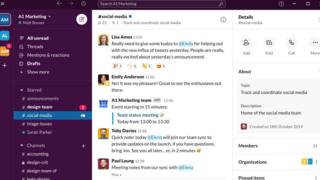
    Slack is designed to make it easier for co-workers to communicate with one another.

    Image copyright
    Slack

    Image caption

    Slack is designed to make it easier for co-workers to communicate with one another.

    Work messaging platform Slack has filed an antitrust claim against Microsoft, claiming the tech giant’s rival app Teams has an unfair advantage.

    Slack said Microsoft’s bundling of Teams within Office 365 software was “illegal and anti-competitive practice” and that the tech giant was “abusing its market dominance”.

    The complaint will now be reviewed by the European Commission.

    Microsoft said that it was providing the EC with information.

    “We created Teams to combine the ability to collaborate with the ability to connect via video, because that’s what people want,” said a spokesperson.

    “With Covid-19, the market has embraced Teams in record numbers while Slack suffered from its absence of video-conferencing. We’re committed to offering customers not only the best of new innovation, but a wide variety of choice in how they purchase and use the product.”

    “We look forward to providing additional information to the European Commission and answering any questions they may have.”

    Slack argued that it was seeking a “level playing field” and suggested that, by offering Teams to Office 365 users, Microsoft was making it harder for Slack to sell its own software to the market.

    “We want to be the 2% of your software budget that makes the other 98% more valuable; they want 100% of your budget every time,” said Jonathan Prince, Slack’s vice president of communications and policy.

    With millions more employees working from home during the pandemic, rivalry over the technology that makes remote working possible has deepened.

    Microsoft Teams users grew from 44 million in March to 75 million in April and Slack has also seen a large rise in users in recent months, reaching 12.5 million by late March.

    The antitrust claim contrasts with comments made by Slack’s chief executive Stewart Butterfield in May, when he told CNBC: “What we’ve seen over the past couple of months is that Teams is not a competitor to Slack.”

    He went on to mention the fact that Microsoft bundles Teams with Office 365 and argued the growth of Teams users during the past three years was unimpressive.

    “They still only have 29% which means 71% of [Office 365] users have said ‘No thank you’.”